
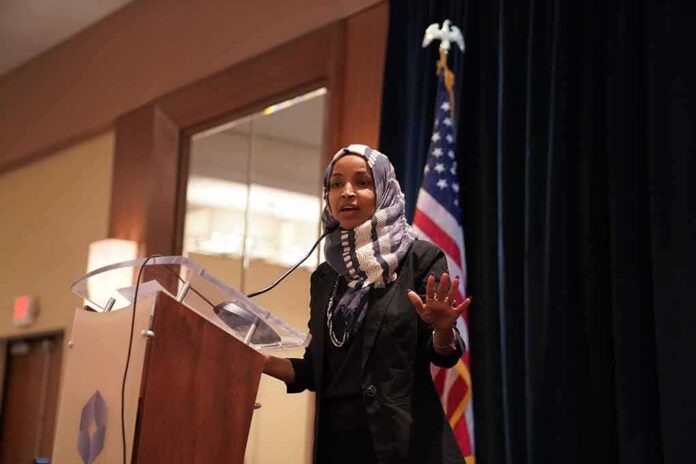
Federal agents searched Rep. Ilhan Omar’s home 22 days before Election Day, and both sides now claim the high ground.
Story Snapshot
- Homeland Security agents executed a judge-approved warrant at Omar’s D.C. home.
- The search came less than a month before voters head to the polls.
- Officials say the criminal probe involves immigration records; no charges were filed.
- Omar cast the raid as political; officials say a judge saw strong evidence.
The search happened, the clock is ticking, and the facts are thin
The Department of Justice said Homeland Security agents carried out a judicially authorized search at Rep. Ilhan Omar’s Washington, D.C., home on October 12, 2026, as part of a criminal investigation. The Associated Press reported the timing: 22 days before Election Day. The government did not describe the evidence or the target scope. USA Today noted that no charges had been filed and that a warrant does not equal guilt. The affidavit remains sealed in public reporting.
The New York Times reported investigators were reviewing immigration paperwork tied to Omar’s family history, including her late father, and possible false statements years ago. That thread matters for two reasons. First, denaturalization cases demand strong, specific proof. Second, records that old are complex. If the record is airtight, prosecutors will say so in court. If it is not, this could be a political thunderclap that fades after votes are cast.
Why timing and process both matter
Federal law enforcement can have probable cause and still pick a tone-deaf time to act. Longstanding Justice Department guidance has warned against overt steps that could sway an election, like raids, close to voting, unless delay would hurt the case. The search here landed inside that caution zone. The government says a judge approved the warrant. ABC and others echoed that point, which signals seriousness to the public. Both statements can be true at once.
That duality is the heart of the dispute. Omar argues politics drove the raid. Officials answer that a judge saw enough evidence to sign. The facts in public do not prove political orders from above. They also do not show the probable cause that convinced the judge, because the affidavit is sealed. Voters are left with signals, not the substance needed to weigh the claim on the merits.
What officials and allies are saying about the evidence
Homeland Security Secretary Markwayne Mullin said multiple warrants were executed and that investigators expected to present the case to a grand jury. Former immigration official Tom Homan said investigators told him they had a “strong case,” while also declining to share details. The government’s public line remains spare: ongoing criminal probe, judge-signed warrant. That cautious posture is normal for active cases, but it sharpens public doubt during election season.
If the probe targets immigration-document fraud, the stakes are real. Homan said that proven fraud could lead to loss of citizenship and removal, a rare but lawful outcome in denaturalization cases. That is a heavy charge that must rest on hard records and credible witnesses, not rumor. American conservative values demand equal enforcement and due process. A strong case should move to indictment and trial. A weak one should be closed, and the public told why.
The line between policing and politics
Searches of elected officials have happened before charges: Donald Trump’s Mar-a-Lago search, Sen. Bob Menendez’s home before indictment, and Rep. Henry Cuellar’s case before his charges. Some led to convictions. Some fizzled. A warrant signals evidence meets a legal threshold, not that a jury will convict. The wise path here is sunlight. Unseal the warrant and inventory with narrow redactions. Show what agents sought and why. Let both sides argue facts, not shadows.
Here is a practical test that honors common sense. First, confirm when this investigation began and whether its scope shifted after Omar’s public clashes with President Trump. Second, release the target description and seized-items list. Third, state whether the probe centers on Omar’s acts or her relatives’ past filings. These steps do not tip the government’s hand to bad actors. They do give voters clarity. If the evidence is strong, daylight will prove it. If not, daylight will save trust.
Sources:
people.com, columbian.com, npr.org, usatoday.com, nytimes.com, abcnews.com, foxnews.com, thehill.com, yahoo.com, electioncases.osu.edu
© featuredheadlines.com 2026. All rights reserved.