

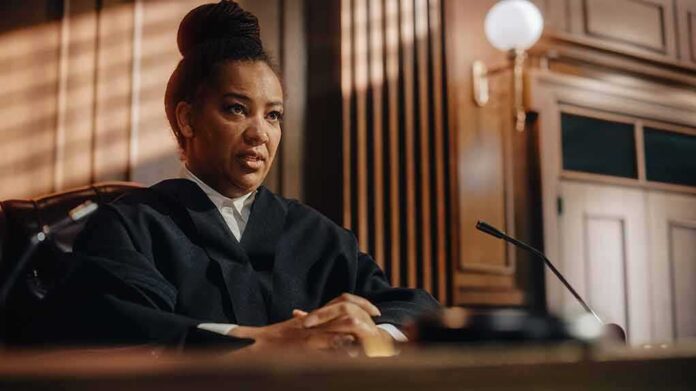
A federal judge’s own courtroom words—quoted as “Black excellence” versus “White mediocrity”—triggered an official misconduct investigation and a sudden pause on her docket, and that should make every citizen sit up.
Story Snapshot
- A hearing transcript reportedly quotes the judge using racial terms toward a lawyer.
- The lawyer filed a misconduct complaint; an investigation followed and her docket paused.
- The judge denies bias, saying her phrasing could have been more delicate.
- Judicial complaints are common; sustained discipline is far rarer.
What the transcript reportedly says and why it matters
Bloomberg Law reports that a hearing transcript quotes U.S. District Judge Ada Brown telling attorney Ezra Young he was “intimidated…with Black excellence, in light of your White mediocrity.” The report also says she described him as “White-presenting,” despite his pushback that he is Latino. Reason summarized more quoted lines about “White privilege” and a “White savior” theme. If those quotes are accurate and in context, they cross from tough judging into identity attacks that have no place in court.
Young filed a judicial-misconduct complaint after the April 2026 Dallas hearing. Bloomberg Law reported that the complaint sparked an investigation and that Judge Brown temporarily lost her docket while the review proceeded. That response matters. Federal courts do not yank a judge’s calendar on a whim. Leaders know that courtroom speech by a life-tenured judge carries the force of the state. When that speech targets a person’s race or perceived race, the public trust takes a hit that is hard to fix.
What the judge says in response
Judge Brown denied that her conduct was inappropriate, while saying her discussions of race could have been handled more gently. She wrote that she would never want anyone to think she favored one race over another. She also cited pride in her Black, White, and Native ancestry and said she wants people to feel comfortable in her court. She argued that Young showed different behavior toward Black lawyers and women than toward white men. That is a serious counterclaim, but it does not excuse racial labeling by the judge.
Courtrooms run on equal treatment and restraint. A judge can correct rude or obstructive conduct without tagging someone’s identity. If a lawyer shows disrespect, sanction the conduct. If a party breaks rules, enforce the rules. But drawing a line from a perceived race to “mediocrity” invites a reasonable reader to see bias. That risk alone shows why judges usually avoid hot-button labels from the bench. American common sense says the robe demands more discipline, not less.
The limits and the open questions
The public has not seen the full official transcript, the complaint, or the investigative orders. Reporters say they reviewed them, but have not posted them. That gap leaves room to fight about tone and context. Still, the investigation and docket pause are documented outcomes that stand on their own. We also lack proof that the judge’s remarks changed any ruling in that case. That matters for remedies, but it does not blunt the damage to trust that public identity barbs can cause.
Federal judicial complaints, including discrimination claims, happen every year. The United States Courts reported 1,857 complaints in 2025 and 1,510 in 2024; many touch bias or discrimination, but only a small share ever lead to discipline. That history warns against rushing to judgment. It also shows this category is not rare, so the process should be transparent where rules allow. Sunshine helps citizens judge the judges. It also protects the innocent when headlines outrun facts.
What should happen next to restore trust
The Fifth Circuit’s judicial council should release nonconfidential records as soon as rules permit. The court should make the full hearing transcript available to the public docket. If audio exists, release it. If the judge’s claim about the lawyer’s conduct holds water, show the examples. If the lawyer’s quotes are accurate and complete, let citizens hear the words in sequence. Equal justice in America depends on neutral judges. That means ruling on law and facts, not on identity or politics.
Sources:
thegatewaypundit.com, reddit.com, threadreaderapp.com, lucianne.com
© featuredheadlines.com 2026. All rights reserved.