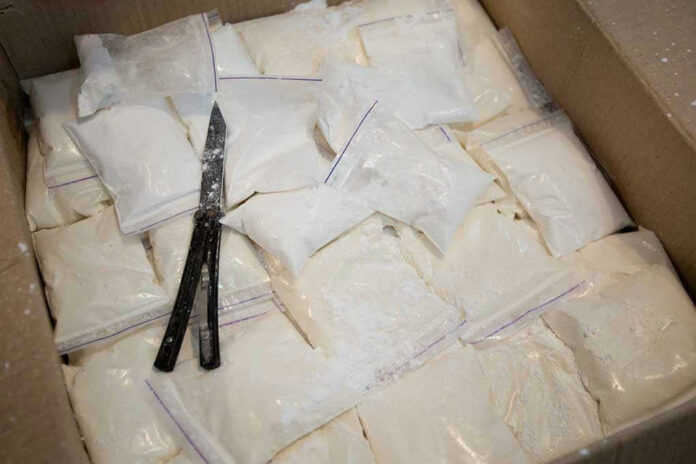
El Salvador’s latest cocaine seizure in the Pacific exposes how international cartels are intensifying their trafficking tactics—right on America’s doorstep—despite years of U.S. investment and globalist promises to curb the drug flow.
Story Snapshot
- El Salvador’s navy hauled in 1.4 tons of cocaine—worth $35 million—floating 1,000 miles offshore, signaling growing cartel sophistication.
- The operation marks a record period for Salvadoran drug interdiction, with over 37 tons seized since 2024.
- U.S.-Salvadoran cooperation is at a high point, but traffickers continue to exploit Central American routes toward the United States.
- Security experts warn cartels are rapidly adapting, raising concerns about future border security and U.S. community safety.
Salvadoran Navy Intercepts Massive Cocaine Shipment Far from Shore
On September 9, 2025, El Salvador’s National Navy announced the interception of 1.4 tons of cocaine floating in the Pacific Ocean, approximately 1,000 miles southwest of its coastline. This haul, valued at $35 million, underscores an alarming evolution in trafficking methods: the drugs were not found aboard a vessel, but packaged and left adrift for later pickup by criminal organizations. The operation demonstrates El Salvador’s expanded maritime reach and its aggressive anti-drug policy in a region long exploited by international cartels.
This seizure is not an isolated case. Between 2024 and 2025, Salvadoran authorities report confiscating over 37 tons of cocaine, with a street value nearing $1 billion. These numbers are unprecedented for the country, reflecting a dramatic escalation in both cartel activity and law enforcement response. President Nayib Bukele, leveraging heightened U.S. cooperation and new surveillance protocols, positioned this operation as a major blow to organized crime, signaling a new era of cross-border and maritime enforcement. The U.S. embassy has praised these efforts, highlighting the bilateral importance of disrupting drug routes that directly impact American communities.
Strategic Shifts: Cartel Tactics and International Response
Drug cartels have long relied on Central America’s Pacific corridor to transport cocaine from South America to the United States. Recent trends indicate traffickers are increasingly using innovative tactics—such as “narco subs,” small craft, and floating caches—to evade detection. The discovery of such a large quantity of cocaine floating so far from any coastline suggests a calculated attempt to reduce interdiction risk and complicate naval operations. El Salvador’s willingness to extend patrols deep into international waters is a direct response to these evolving threats and demonstrates a significant investment in regional security infrastructure.
The strategic importance of Central America as a transit route cannot be overstated. While Salvadoran authorities are disrupting shipments, experts caution that cartels will continue adapting, shifting routes and methods to exploit any gaps in enforcement. This cat-and-mouse dynamic raises critical questions about the long-term effectiveness of current strategies and the potential for traffickers to redirect their operations toward other vulnerable points—potentially closer to the U.S. southern border, with all the attendant risks for American families and communities.
Stakeholders, Impact, and the U.S. Security Dilemma
The primary players in this unfolding drama are El Salvador’s navy, President Bukele’s administration, international drug cartels, and U.S. security officials. Bukele’s government aims to bolster its reputation by cracking down on organized crime and strengthening ties with Washington. For the U.S., these operations are vital: every ton of cocaine intercepted in Central America is one less that reaches American streets, where it fuels crime, addiction, and community breakdown.
In the short term, the loss of $35 million is a significant blow to criminal networks, disrupting their financial and logistical operations. For coastal communities in El Salvador and beyond, reduced trafficking can mean fewer incidents of cartel-related violence and corruption. Politically, these successes bolster the image of strong, security-focused leadership, a stark contrast to years of perceived globalist neglect and border insecurity that many conservative Americans find frustrating. However, experts warn that traffickers are likely to respond with even more sophisticated evasion tactics, making continued vigilance and cooperation essential.
Expert Perspectives and Future Outlook
Security analysts emphasize the need for ongoing international collaboration, sophisticated intelligence sharing, and operational innovation to keep pace with rapidly adapting cartels. While Salvadoran and U.S. authorities celebrate recent successes, some regional experts caution against potential overreach or escalation in enforcement tactics, which could trigger legal or human rights concerns in the future. Nonetheless, the consensus is clear: the battle for control over drug routes in the Americas is intensifying, and failure to adapt risks eroding U.S. security, sovereignty, and the safety of American families.
Sources:
Bukele’s security administration strikes another major blow against drug trafficking
1.4 tons cocaine found floating in Pacific Ocean by El Salvador’s navy
Salvador seizes 1.4 tons of cocaine floating in the Pacific Ocean
El Salvador deals severe blow to international drug trafficking