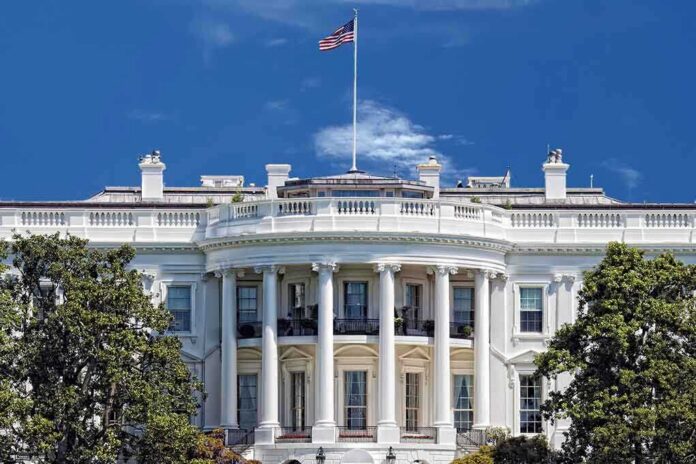
A suicidal man traveling hundreds of miles from Indiana to the nation’s capital brandished a handgun at Secret Service agents near the White House just after midnight Sunday, triggering an armed confrontation that ended with agents firing shots and the man hospitalized.
Story Snapshot
- Indiana police alerted federal authorities Saturday about a suicidal individual heading to Washington, D.C., enabling Secret Service to locate his parked vehicle near the White House perimeter
- Agents confronted the man at 17th and F Streets NW, one block west of the White House, where he brandished a handgun and Secret Service personnel fired shots
- No Secret Service agents were injured, and the hospitalized suspect’s condition remains unknown as D.C. Metropolitan Police lead the use-of-force investigation
- President Trump was at Mar-a-Lago during the incident and returned to the White House later Sunday without disruption
When Intelligence Prevents Disaster
The shooting unfolded because Indiana law enforcement did something critical: they shared intelligence in real time. Local police notified federal authorities Saturday after identifying a suicidal individual potentially en route to Washington. That advance warning allowed Secret Service agents to locate the man’s parked car near the Eisenhower Executive Office Building before he approached on foot. The confrontation occurred in one of the most heavily secured zones in America, yet the incident never triggered a White House lockdown or evacuation. This wasn’t random chaos; it was coordinated response meeting individual crisis.
The Secret Service statement confirmed agents fired shots after the man brandished a firearm during their approach. Law enforcement sources identified the weapon as a handgun. The sequence suggests agents recognized the threat immediately, acted within protocols for armed confrontations, and neutralized the danger without casualties among federal personnel or bystanders. The man was transported to a local hospital, though authorities have not disclosed his identity or medical condition. D.C. Metropolitan Police assumed investigative authority over the use-of-force incident, standard procedure when federal agents discharge weapons within the district’s jurisdiction.
Echoes of Past White House Threats
This incident mirrors a 2016 shooting at the White House checkpoint where Jesse Olivieri, a 30-year-old Pennsylvania man with a documented mental health history, approached agents with a firearm at 17th and E Street. He ignored commands, prompting Secret Service to shoot him in the stomach. No one else was injured, though the White House locked down for 45 minutes. President Obama was absent; Vice President Biden was secured. Investigators found no terrorism connection, attributing the act to mental illness rather than political motive. The pattern holds: individuals in crisis, not coordinated plots, drive most White House perimeter threats.
The overnight timing of Sunday’s shooting minimized public disruption. President Trump remained at Mar-a-Lago, scheduled to return at 5 p.m. Sunday, hours after the scene cleared. Secret Service protocols emphasize rapid threat assessment when weapons appear, especially near the West Wing area where the Eisenhower Executive Office Building houses senior staff offices. The absence of a broader lockdown signals agents contained the threat swiftly, preventing escalation that could have paralyzed downtown Washington during early morning hours when foot traffic is minimal but security stakes remain high.
When Mental Health Crises Meet Federal Security
Suicidal intent complicates threat assessment. The man traveled from Indiana with apparent plans involving the White House, yet his motivation stemmed from personal crisis, not assassination intent or terrorism. Secret Service agents train for armed encounters, but distinguishing between a suicidal individual seeking confrontation and an assassin requires split-second judgment. The decision to fire shots suggests the brandished handgun left no margin for hesitation. Critics of law enforcement might question whether de-escalation was attempted, but when a firearm emerges near the president’s residence, agents default to neutralizing threats, not negotiating.
Inter-agency cooperation proved essential. Indiana police shared actionable intelligence that allowed Secret Service to preemptively locate the suspect’s vehicle and intercept him on foot. This reflects post-9/11 improvements in federal-state information sharing, where local tips about individuals traveling to high-security sites reach protective agencies fast enough to prevent attacks. The system worked: agents identified the man before he reached the White House grounds, engaged him outside the secure perimeter, and prevented a scenario where he could have breached checkpoints or endangered tourists who frequent the area during daytime hours.
What Comes Next
D.C. Metropolitan Police will scrutinize the use-of-force, examining whether agents followed protocols for armed confrontations and whether the shooting was justified. Given the man brandished a firearm and no Secret Service personnel were injured, the investigation will likely conclude agents acted appropriately. The suspect’s condition and potential charges remain unknown, though federal prosecutors could pursue weapons violations or threatening a protected site if he survives. Secret Service may review whether enhanced protocols are needed for intercepting individuals flagged by out-of-state police, though the rapid response here suggests current systems functioned as designed.
The incident underscores an uncomfortable truth: mental health crises frequently collide with federal security, forcing split-second decisions where lives hang in the balance. The Secret Service protected the White House without casualties among their ranks, a testament to training and intelligence sharing. Yet a man from Indiana now lies in a hospital, his fate uncertain, his crisis unresolved. Whether this prompts deeper conversations about mental health intervention before individuals reach the nation’s capital remains to be seen, but Sunday’s shooting proves that even preemptive alerts cannot always prevent violence when desperation meets federal authority.
Sources:
Secret Service shoots man in overnight armed confrontation near White House – Fox29
Secret Service shoot armed man near White House – CBS News
2016 White House shooting – Wikipedia