
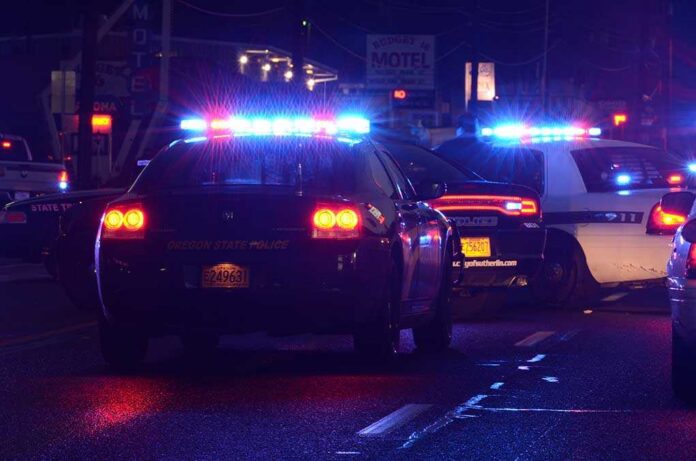
Two Dallas dashcam releases show the same brutal truth: a split-second decision gets made long before the public ever hits “play.”
Quick Take
- Dallas police released dashcam footage in two separate fatal encounters: an ambush aftermath and a SWAT standoff near a children’s hospital.
- In the ambush case, Officer Darron Burks was killed and two officers were wounded before the suspect fled and later approached officers with a gun.
- In the hospital-garage standoff, the suspect was wanted on impersonation allegations and died after pointing a gun at SWAT, according to the report.
- The political fight over “vetting” security contractors doesn’t change the street-level reality: guns plus defiance compress time and choices.
Dashcam Footage Turns Arguments Into Timelines, Not Talking Points
Dallas Police Department dashcam footage didn’t just document danger; it documented sequence. That matters because modern debates about officer-involved shootings often skip the order of events and jump straight to motive. In these Dallas cases, the department’s releases highlighted a familiar pattern: officers issue commands, a suspect changes posture or closes distance, and the final seconds become irreversible. The videos function as transparency, but they also become evidence in the court of public opinion.
The uncomfortable part for viewers is how ordinary the key movements look: a door opens, a hand disappears, a person steps forward. The dashcam doesn’t provide a narrator or a conscience; it provides distance, audio fragments, and the clock. For citizens who want clean moral categories, the footage forces a simpler question: what would you do if the person in front of you ignored lawful commands while holding, reaching for, or pointing a firearm?
The Ambush Aftermath: When an “Execution” Sets the Tone for Everything That Follows
The first incident began with an ambush that killed Officer Darron Burks, a 46-year-old who had reportedly spent years as a math teacher before joining the department. A distress call came in around 10 p.m., and responding officers were attacked; two were wounded, including one shot in the face, and were expected to survive. Dallas leaders framed it as a targeted killing of an officer in uniform, which hardens public expectations for a decisive response.
After the ambush, the suspect fled, prompting a pursuit that ended on a freeway. According to the report, the suspect exited the vehicle with hands raised, then returned to the vehicle, retrieved a firearm, and began approaching officers despite commands to drop the weapon. The fatal shooting occurred in that closing distance. That detail—approaching officers while armed—tends to be the hinge point in how Americans assess these cases, especially those who prioritize rule of law.
The Hospital Garage Standoff: High Stakes, Tight Space, and a Political Shadow
The second dashcam release carried a different kind of heat because it intersected with national politics. Police served a warrant on Diamon-Mazairre Robinson, also known as “Mike King,” in connection with allegations of impersonating a police officer. The standoff unfolded in a parking garage at Children’s Medical Center Dallas, a location that instantly elevates risk. A garage compresses angles, limits cover, and raises fears about stray rounds near families and staff.
Police used tear gas, and Robinson eventually exited and pointed a gun at SWAT, according to the account; officers shot and killed him, and the report states he did not fire. Rep. Jasmine Crockett issued a statement defending him while also arguing that “loopholes” in congressional security vetting contributed to the situation. The conservative common-sense read is straightforward: procurement failures deserve scrutiny, but they don’t neutralize an armed threat in real time.
Impersonation Schemes and Replica Authority: Why This Crime Isn’t “Nonviolent” in Practice
Some defenders lean on the claim that Robinson had no confirmed violent offenses. Even if accurate in a narrow charging-history sense, impersonating law enforcement carries an obvious violence-adjacent risk: it borrows state authority to control other people. Reports described a replica police car, stolen plates, fake uniforms, and a scheme that allegedly included hiring real officers through a business front. Add multiple recovered firearms, including one reported stolen, and the public has every reason to worry.
Impersonation crimes also poison trust for legitimate officers. Every fake badge makes the next traffic stop more dangerous because citizens wonder who is real. Conservatives tend to view this through a responsibility lens: authority must be earned, verified, and accountable. When a suspect who’s accused of playing cop ends up in a SWAT standoff, the storyline isn’t “paperwork went wrong.” The storyline is that borrowed authority can escalate into real-world terror fast.
What the Videos Don’t Show, and Why That Gap Fuels Suspicion
Dashcam releases can clarify sequence, but they rarely answer every question. Viewers may not see what officers saw just before the camera angle stabilized, what dispatch told them about the suspect, or what other units reported. They also don’t show what de-escalation attempts occurred earlier, off camera or before the first recorded frame. That gap creates an opening for partisan narratives, especially when a member of Congress becomes even indirectly connected to the suspect’s employment.
Still, the strongest factual anchor across both events is the same: the suspect was armed and failed to comply at the moment force was used. That does not make every shooting morally simple, but it does make the operational logic clear. Police are not required to gamble on whether a gun will be fired after it’s produced or aimed. From a law-and-order standpoint, that’s the line society draws to keep public spaces governable.
The Real Reform Target: Vetting, Transparency, and Personal Accountability
If policymakers want a serious takeaway, they should separate two issues that get mashed together online. First: agencies and governments should tighten vetting systems that allow questionable operators to drift into security work around sensitive people and places. Second: individual accountability remains non-negotiable when a person chooses to reach for a gun, point a gun, or advance on officers. No procurement reform can substitute for self-control in the last ten seconds of a confrontation.
Dallas’s decision to release footage signals a bet that transparency beats rumor, even when the footage is grim. That bet carries risk; videos can inflame as easily as they inform. But the alternative—silence—invites conspiracy and erodes confidence for everyone, including good officers trying to go home. The uncomfortable lesson is that many tragedies don’t begin with the trigger pull; they begin with the first unlawful choice that forces everyone else to react.
Sources:
Video: Dallas PD releases footage in fatal OIS of man who ‘executed’ officer in ambush shooting
Jasmine Crockett defends security guard killed in police standoff, wanted for impersonating cop