

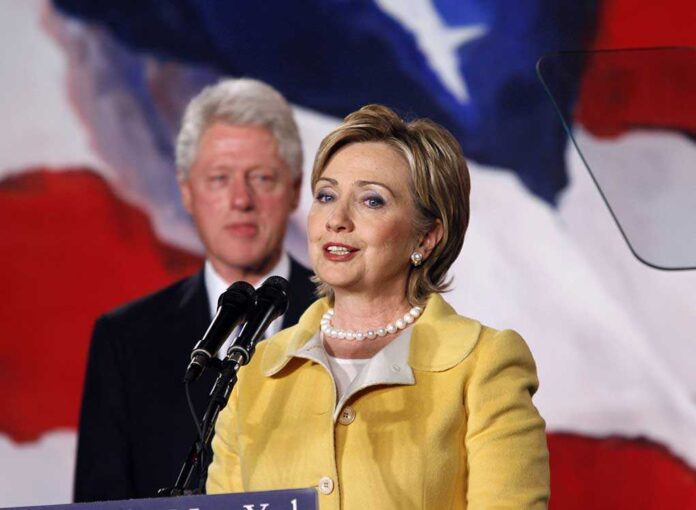
Two of the most powerful Democrats in modern America now face a blunt choice next week: walk into a closed House deposition on Jeffrey Epstein, or stare down contempt of Congress.
Story Snapshot
- House Oversight has subpoenaed Bill and Hillary Clinton for closed-door Epstein depositions, with dates locked in for next week.
- Committee leaders warn both could face formal contempt of Congress proceedings if they do not appear as ordered.
- The clash tests whether Congress applies subpoena power equally to Democratic icons and Trump-world figures alike.
- The broader probe targets how federal law enforcement handled Epstein and Maxwell across multiple administrations, not just the Clintons’ ties.
Congress Tries To Drag Power Into the Light
The Republican-led House Oversight and Accountability Committee did not stumble into this showdown; it engineered it over months, using one of Congress’s sharpest tools: the subpoena. In July 2025, its Federal Law Enforcement Subcommittee, on a bipartisan voice vote, authorized subpoenas for ten high-profile figures, including Bill and Hillary Clinton, to investigate federal handling of Jeffrey Epstein and Ghislaine Maxwell. Chairman James Comer then issued formal subpoenas on August 5, 2025, demanding in-person depositions.
Those subpoenas are not about gossip; they target concrete questions: what contact the Clintons had with Epstein and Maxwell, what they knew about his activities, and what, if anything, federal law enforcement shared or failed to share. The committee’s mandate extends beyond the social circle narrative into how DOJ and FBI under both parties handled a predator who moved comfortably among elites for years. That scope matters, because it undercuts the idea this is only a partisan stunt.
The Clintons’ Delays and the Contempt Tripwire
The first showdown already happened quietly in December. Bill was initially set for a December 17 deposition and Hillary for December 18. Their attorney, David Kendall, told the committee his clients could not attend because of a funeral and proposed written responses instead, casting that option as more efficient and equitable. Comer flatly rejected that offer, insisting Congress has the right to question them face-to-face rather than through carefully lawyered written statements.
After that failed December round, the committee drew a brighter line. It rescheduled Bill Clinton for January 13 and Hillary Clinton for January 14, behind closed doors in the Capitol complex. As of this week’s reporting, a committee spokeswoman says neither has confirmed attendance and warns that if they do not show, the panel will initiate contempt of Congress proceedings. From a rule-of-law, conservative perspective, this is exactly where consistency is tested: if Bannon and Navarro can be prosecuted for ignoring subpoenas, former Democratic leaders cannot be treated as a protected class.
A Wider Net Than Just the Clintons’ Flight Logs
The subpoenas to the Clintons sit inside a much broader dragnet. Oversight also targeted former Attorneys General and senior law-enforcement leaders from both parties, including Eric Holder, Loretta Lynch, Merrick Garland, William Barr, Jeff Sessions, Alberto Gonzales, former FBI Director James Comey, and special counsel Robert Mueller. That list makes one thing plain: this investigation is probing institutional performance across multiple administrations, not just the social calendars of two Democrats.
According to the committee’s own public statements, its core questions focus on why Epstein received lenient treatment, how earlier allegations were handled or ignored, and whether politically connected figures received special consideration from DOJ and FBI. From a common-sense conservative view, those are precisely the questions Congress should ask when an elite predator evades full accountability for years. If anything, the glaring problem would be refusing to ask them because powerful names might be embarrassed.
Accountability, Double Standards, and What Happens Next
Next week’s depositions, if they occur, will not be televised fireworks but closed-door grind. Transcripts could emerge later, and those records would shape public judgment more than any spin from either side. If the Clintons attend, they submit to the same process Republicans endured during the January 6 investigations, proof that oversight, while often ugly, still reaches both camps. If they do not, the committee has openly promised a contempt process.
Contempt itself is not the finish line. Once the House votes, the referral goes to the Department of Justice, which decides whether to prosecute. Recent history shows how political that decision can look: DOJ prosecuted Steve Bannon and Peter Navarro, but declined to act on a contempt referral for Attorney General Merrick Garland over Biden interview audio. If DOJ now balks at enforcing a contempt referral against the Clintons after aggressively pursuing Trump allies, skepticism about double standards in federal law enforcement will only deepen. Americans over 40 have watched this movie enough times to recognize the pattern, and to demand, finally, that the rules apply the same way to everyone in the credits.
Sources:
Politico – House GOP threatens to hold Clintons in contempt over Epstein probe
NCSHA – High-profile congressional testimonies and political transparency (meta context)