When U.S. embassies start quietly telling Americans in the Middle East to be “ready to depart,” it means Washington thinks Iran is closer to striking than most people want to believe.
Story Snapshot
- U.S. embassies across the Middle East are warning Americans to be prepared to leave as tensions with Iran rise.
- Travel advisories now label much of the region “Reconsider Travel” or “Do Not Travel,” with airports already disrupted.
- The State Department is drawing down nonessential diplomats and reviewing security at posts worldwide after strikes on Iran.
- Officials say the moves are defensive, but the scale of the military buildup also gives President Trump strong offensive options.
Embassy warnings signal a dangerous phase in the Iran confrontation
United States embassies in the Middle East have begun issuing blunt, country-specific alerts telling Americans to be cautious, expect travel chaos, and be prepared to depart on short notice. At least eleven missions, from Bahrain and Kuwait to Jordan, Qatar, Saudi Arabia, and the United Arab Emirates, have warned that flight options are shrinking as tensions with Iran escalate and airspace closures spread across the region. These are not routine advisories. This language appears when Washington believes the threat environment is unstable and can deteriorate fast.
Embassy messages stress that the situation is “fluid” and that Iran is “unpredictable,” noting recent decisions by Tehran to hit new targets with little warning, including areas that had not been attacked before. Citizens are told to expect possible explosions, sirens, and sudden airspace shutdowns, and to have a plan to shelter in place or leave as conditions allow. For older Americans who remember previous Gulf crises, this has the feel of a prelude: officials do not know exactly where the next blow will land, only that it is more likely.
Travel advisories move from caution to “Do Not Travel” and ordered departures
The State Department’s formal travel advisories now paint a stark map. Bahrain, Israel, the West Bank, Jordan, Kuwait, Oman, Qatar, Saudi Arabia, and the United Arab Emirates are at Level 3, which means “Reconsider Travel.” Iran, Iraq, Lebanon, Syria, Gaza, and Yemen are at Level 4, “Do Not Travel,” the highest warning level. On top of that, Washington has issued a worldwide caution notice, telling Americans everywhere, but especially in the Middle East, to raise their guard against Iran-linked groups that may target U.S. interests. These steps fit a pattern: when missiles start flying, travel freedom vanishes first.
Behind the scenes, the government has started pulling its own people out. The State Department has ordered nonessential diplomatic staff and their families to leave embassies in Saudi Arabia and Bahrain, as well as a consulate in Adana, Turkey, after Iranian reprisals against joint U.S.-Israeli operations. Nonessential staff were also told to depart Lebanon after strikes on Iranian nuclear sites. Once Washington reduces its footprint and tells its own workers to go, Americans living or traveling in the region should understand the signal: you may not have much help if things go bad and you choose to stay.
Emergency flights and worldwide security reviews underline perceived Iranian threat
To match the warnings, the United States has expanded emergency evacuation flights for citizens trying to leave Israel and other hot spots. The State Department says it has helped more than 23,000 people either with information or seats on charter flights as closed airspace and canceled routes made normal travel unreliable. At the same time, embassies in some countries, such as Bahrain and parts of Kuwait, have temporarily closed or told citizens to stay indoors, underscoring the risk of direct attacks or unrest. This is crisis management, not tourism advice.
Washington is not only looking outward. A cable obtained by reporters shows the State Department ordered “ALL posts worldwide” to immediately convene their Emergency Action Committees to review threats and security posture in light of the evolving Middle East situation. That means this is not seen as a local flare-up, but as a regional shock with possible global spillover. Iran and its allied groups have long-range tools: missiles, drones, cyber attacks, and covert cells. Conservative common sense says you plan as if those tools will be used, not as if Tehran will suddenly become responsible.
Defensive protection and hard-nosed leverage go hand in hand
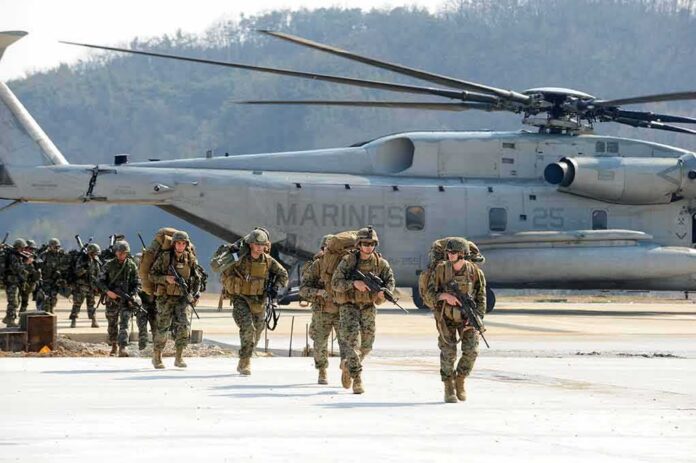
U.S. military and government officials insist these embassy alerts and travel warnings are meant to protect Americans, not to pave the way to war. That claim fits the broader picture of a massive, mostly defensive buildup. Since early 2026, the United States has carried out its largest Middle East force surge since the 2003 Iraq invasion, deploying multiple aircraft carriers, bombers, missile defenses, and tens of thousands of troops around Iran. Officials describe added fighter jets as “primarily defensive,” aimed at shielding bases and personnel from Iranian retaliation. On its face, that is sound stewardship of American lives.
But large deployments are never just defensive. Analysts across outlets from Cable News Network (CNN) to Radio Free Europe say this buildup also gives President Trump strong coercive options if talks with Tehran fail. The same carrier groups and air wings that can intercept Iranian missiles can also strike Iranian infrastructure and nuclear sites. From a conservative perspective, that dual purpose is not a bug; it is a feature. Peace is likelier when your enemies know you can hit back hard and fast, even while you publicly stress defense.
What this means for Americans watching from home
For Americans following this from a safe distance, the embassy line “be prepared to depart” should cut through the noise. It tells us Iran has both the means and the will to expand its attacks, possibly into countries that have felt safe until now. It also shows that, whatever critics say, the U.S. government is treating the threat seriously: warning citizens, backing those warnings with emergency flights, and reinforcing regional forces so that any hit on American troops or facilities can be answered. That mix of caution and strength aligns with core conservative values: protect your people, project power, and do not wait for the enemy to get lucky.
Sources:
mediaite.com, en.wikipedia.org, nytimes.com, reuters.com, military.com, youtube.com, pbs.org, cnn.com
© featuredheadlines.com 2026. All rights reserved.