featuredheadlines.com — A federal judge just handed President Trump a significant early victory in the fight over mail-in voting, and the battle is only getting started.
Quick Take
- A Washington D.C. federal judge declined to block Trump’s executive order tightening mail-in voting rules, allowing implementation to proceed.
- The court ruled the legal challenge was premature because federal agencies had not yet begun carrying out the order’s directives.
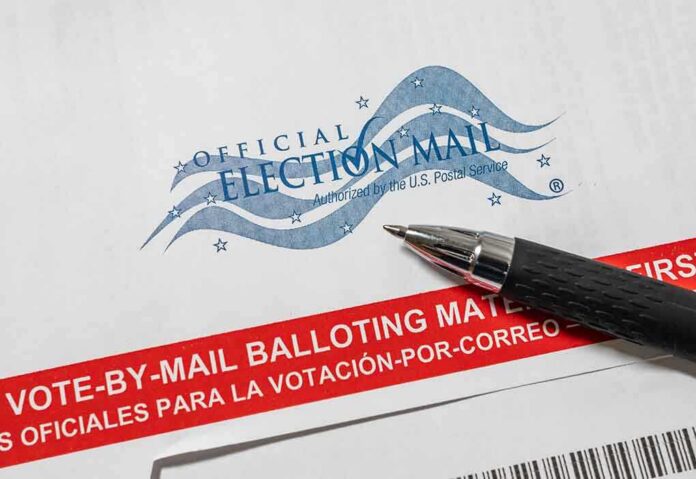
- Trump’s order directs federal agencies to compile voter-eligibility data and instructs the U.S. Postal Service to restrict mail-in ballots to verified eligible voters only.
- Voting rights groups argue the president lacks constitutional authority to regulate elections, setting up a longer legal war ahead of the midterms.
What the Judge Actually Decided and Why It Matters
Federal judge Carl Nichols, a Trump appointee sitting in Washington D.C., declined to issue a preliminary injunction blocking the executive order on mail-in voting. His reasoning was procedural, not a full endorsement of the policy. The court found that the Department of Homeland Security and the U.S. Postal Service had not yet implemented the order’s key directives, meaning the plaintiffs’ claimed injuries were speculative at this stage. No harm had materialized yet, so no emergency block was warranted. [4]
That distinction matters enormously. A refusal to block is not a ruling that the order is constitutional or legal. It simply means the challengers jumped the gun. The court is essentially saying: come back when something actually happens to someone. That is standard judicial restraint in pre-enforcement challenges, and it is the correct call given the facts on the ground at the time of the ruling. [12]
What Trump’s Executive Order Actually Does
Signed in March 2026 and formally titled “Ensuring Citizenship Verification and Integrity in Federal Elections,” the order directs federal agencies to compile lists of eligible voters in each state and instructs the Postal Service to refuse mail-in ballots from anyone not on those verified lists. The White House frames this as a citizenship verification and election integrity measure, invoking the Help America Vote Act as partial legal authority. [11] Critics at the Brennan Center for Justice describe the order’s principal thrust as placing the Postal Service in the position of deciding who may vote by mail, a role historically held by states. [8]
That framing gap is where the real legal war lives. States have long held primary authority over election administration under the Constitution. The president directing a federal agency to gatekeep ballot access is a genuinely novel assertion of executive power. Whether it is lawful depends on statutory interpretation and constitutional limits that no court has fully resolved yet, which is precisely why this fight is far from over.
The Opposition’s Case and Where It Stands
A coalition of voting rights organizations filed suit in the U.S. District Court for the District of Massachusetts, arguing the order constitutes illegal interference in elections and that the president lacks constitutional authority to regulate how Americans vote. They point to Trump’s prior voting executive order, which failed in court, as precedent for skepticism. [9] The American Civil Liberties Union of Massachusetts is among the groups backing the challenge, and the Democracy Docket has separately reported that a judge permanently blocked key portions of an earlier Trump elections executive order. [3]
BIG WIN FOR PRESIDENT TRUMP & ELECTION INTEGRITY!
Federal judge UPHHELD the President’s Executive Order — MAIL-IN VOTING STANDS exactly as signed!
Rule of Law upheld .@TheDemocrats are scrambling back to the drawing board trying to figure out how to get around it.
Securing… pic.twitter.com/PVYuJbk97g
— Erica 🇺🇸🇺🇸🇺🇸 (@EricaRN4USA) May 29, 2026
The opposition’s argument has real constitutional weight behind it. Article I of the Constitution grants states broad authority over the time, place, and manner of elections, with Congress holding override power. The president’s role in that framework is narrow. However, the challengers have a credibility problem of their own: crying wolf before the agencies have done anything makes courts reluctant to act, and that is exactly what happened here. The judge’s procedural dismissal of the urgency argument is a tactical setback that the opposition handed to itself. [12]
Why This Fight Will Intensify Before the Midterms
The midterm elections are the clock ticking in the background of every filing in this case. Trump’s Republicans face competitive battles to retain control of both chambers of Congress, and mail-in voting has become a proxy battleground for broader arguments about administrative control and trust in elections. [7] Once the Postal Service and federal agencies begin actually implementing the voter eligibility lists, the pre-enforcement problem disappears and the courts will have no procedural escape hatch. Expect the litigation to accelerate sharply the moment any agency takes a concrete action under the order.
The core question courts will eventually have to answer is whether a president can use federal agencies to reshape who receives a mail ballot, or whether that power belongs exclusively to the states and Congress. That question is not settled. What is settled, for now, is that the order stands, the clock is running, and the next ruling in this fight will carry far more weight than this one did.
Sources:
[3] YouTube – Federal judge blocks Trump Admin. orders aimed at vote-by-mail in …
[4] Web – In major rebuke, federal judge blocks key parts of Trump’s anti …
[7] Web – A federal judge in D.C. declines to block Trump’s executive order on …
[8] Web – Trump scores big court win as judge refuses to block mail-in voting …
[9] Web – Analyzing the President’s Executive Order on Mail Voting
[11] Web – Voting Rights Groups Challenge Executive Order on Mail-In Ballots …
[12] Web – Ensuring Citizenship Verification and Integrity in Federal Elections
© featuredheadlines.com 2026. All rights reserved.