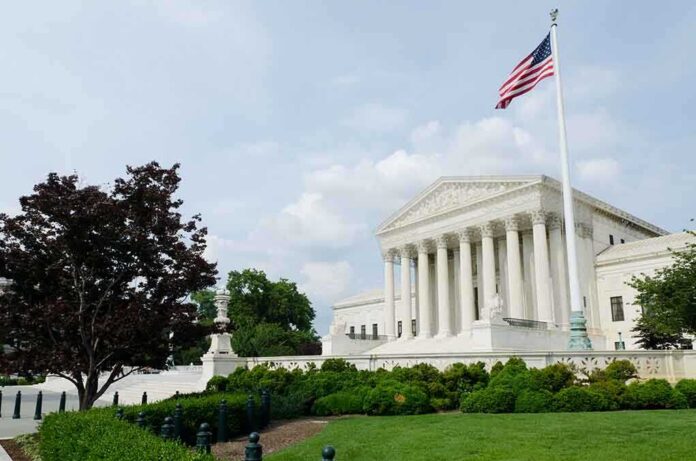
The Supreme Court is about to decide whether an IQ number can outweigh medical judgment when the state wants to kill a man.
Story Snapshot
- The case Hamm v. Smith will define how “intellectual disability” is measured when a state seeks the death penalty.
- Alabama asks the Court to let a single IQ score override clinical diagnoses and adaptive‑functioning evidence.
- Disability advocates warn this could reopen the door to executing people the Court already promised to protect.
- The ruling could spill far beyond death row into disability law, education, and benefits.
How Hamm v. Smith Put One Number on Trial
Joseph Clifton Smith has lived most of his adult life in a concrete cell because of a murder he committed in Alabama in 1997, but his case now forces the country to answer a more unsettling question: how do we decide who is too disabled to execute. Under Atkins v. Virginia, people with intellectual disability cannot be put to death, yet Alabama insists Smith’s IQ scores, which fall above a fixed cutoff, should settle the matter in its favor even when doctors say otherwise.
Smith’s lawyers counter with the very standards the Supreme Court itself has cited for two decades: intellectual disability is not a single test result, but a lifelong condition assessed through three pillars, subaverage intellectual functioning, serious limits in everyday life skills, and onset before adulthood. Professional groups like the American Association on Intellectual and Developmental Disabilities stress that IQ tests have a margin of error and must be read alongside evidence of how a person actually functions in the real world.
The Court’s Tug-of-War Between Science and State Power
Atkins in 2002 established the constitutional rule, but left the details to the states, and that gap is where the trouble began. Some states quickly built tight gates: hard IQ cutoffs, home‑grown checklists, and courtroom stereotypes that treated disability as a loophole rather than a diagnosis. In Hall v. Florida, the Court slapped down Florida’s rigid “70 and out” IQ rule and ordered judges to account for measurement error and modern clinical definitions instead of pretending the test was a blood‑pressure cuff.
Texas then tried another end run with the so‑called Briseño factors, relying on lay impressions of whether a defendant seemed disabled enough, prompting the Court in Moore v. Texas—twice—to insist that states cannot invent pseudo‑medical tests to narrow the protected class. Alabama now asks an even more direct question: can a state simply elevate IQ scores back to near‑total control, relegating adaptive‑functioning evidence and expert diagnoses to bit‑part status whenever the number looks inconvenient. For a conservative Court that often preaches deference to states, this is where constitutional guardrails collide with law‑and‑order instincts.
What Conservatives Should See at Stake Beyond One Defendant
Conservative values emphasize personal responsibility, but also basic fairness and restraint on government power. Executing people whom medical experts conclude cannot fully grasp consequences or navigate basic life demands looks less like accountability and more like the state flexing power against the weakest. A bright‑line IQ rule may sound tidy, yet it ignores the real‑world reality that two people with the same score can have radically different abilities to understand legal proceedings or assist their own defense.
Nothing about enforcing Atkins requires sympathy for crime; it requires consistency about what the Eighth Amendment means. If Alabama prevails, states will have a green light to tighten the definition of intellectual disability until the formal protection remains while its real‑world coverage shrinks. That kind of bait‑and‑switch invites exactly the kind of arbitrary punishment the framers meant the cruel‑and‑unusual clause to restrain. A principled conservative reading would ask whether the state’s position expands its power to the point that a constitutional promise becomes a numbers game.
Disability advocates warn that once the Court lets states downgrade clinical judgment in capital cases, the same logic will tempt policymakers elsewhere. Courts and agencies already lean on intellectual‑disability definitions in Social Security disability claims, special‑education eligibility, and access to services. Legal analysts note that a ruling blessing a narrow, IQ‑centered view in Hamm v. Smith could ripple into those arenas, subtly pressuring decision‑makers to treat nuanced clinical conditions as if they were credit scores.
Why This Ruling Will Outlive the Death Penalty Debate
The practical short‑term impact is stark. If the Court reaffirms Hall and Moore and demands holistic, science‑based assessments, Smith and others like him are more likely to be found categorically ineligible for execution and resentenced to life imprisonment. If it sides with Alabama, men with borderline scores and deep adaptive impairments will remain on the execution list, and states will face little downside in framing disability narrowly, knowing the justices have blessed their framework.
Longer term, Hamm v. Smith is about who defines reality when constitutional rights meet specialized knowledge. Previous Courts said the Eighth Amendment’s “evolving standards of decency” should pay attention to emerging consensus and modern science. This Court must decide whether that promise still holds or whether, in the name of orderly criminal justice, it will let a spreadsheet cell trump the judgment of the very experts the law has long relied on to identify those whom the state is not permitted to kill.
Sources:
SCOTUS to Determine Definition of Intellectual Disability