

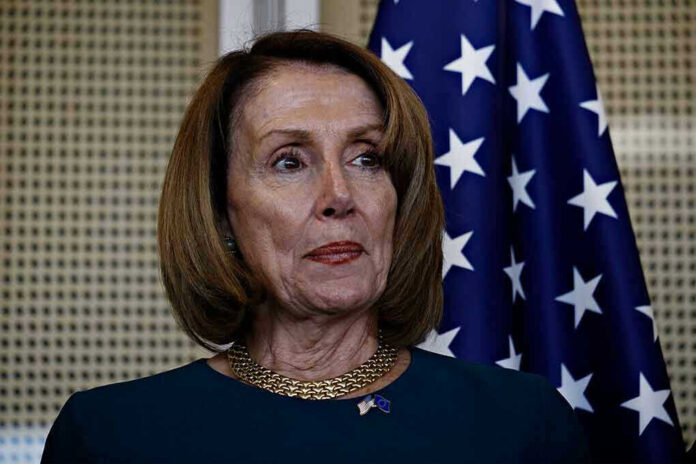
President Trump has just called for a sweeping investigation into Nancy Pelosi’s alleged insider trading, as the Senate advances a bill that could finally put an end to congressional stock market profiteering—and the political class is scrambling.
At a Glance
- Trump demands an official probe into Nancy Pelosi’s stock trades, reigniting a national debate on congressional ethics
- The Senate committee advances the PELOSI Act—a bill named for Pelosi herself—to ban lawmakers and their spouses from trading individual stocks
- Pelosi denies wrongdoing, supports the bill, and claims she welcomes higher ethical standards
- Public outrage grows over Congress members cashing in while Americans struggle with inflation and economic uncertainty
Trump Targets Pelosi as Senate Pushes Ban on Congressional Stock Trading
President Donald Trump, never one to mince words or shy from controversy, has once again put Nancy Pelosi squarely in the spotlight. On July 30, 2025, Trump publicly called for a full-scale investigation into the former House Speaker, accusing her of getting rich off insider information while the rest of us watched our retirement accounts shrivel. This comes as the Senate committee narrowly advanced the so-called “PELOSI Act,” a bill tailor-made to stop lawmakers—Pelosi included—and their spouses from trading or holding individual stocks. The timing is no accident. Americans have long suspected D.C. politicians of playing by a different set of rules, and now, the calls for accountability are too loud for Congress to ignore.
The PELOSI Act, championed by Senator Josh Hawley, does more than just slap a new set of restrictions on lawmakers. It signals that the days of congressional members cashing in on privileged information might finally be numbered. But let’s not kid ourselves—Pelosi’s high-profile stock trades, especially those made by her husband, have been notorious for years, often outpacing the market and raising more than a few eyebrows. With Trump’s demand for an investigation and the Senate’s action, we’re seeing a rare moment of bipartisan agreement—at least on the surface. But don’t expect the political establishment to give up their perks without a fight.
Pelosi Defends Herself as Public Skepticism Reaches Boiling Point
Pelosi, for her part, isn’t playing the shrinking violet. She’s welcomed the new bill, claiming to support any “serious effort to raise ethical standards in public service.” Yet, the public isn’t buying it. Americans are sick and tired of watching lawmakers get rich while the country faces sky-high inflation, out-of-control spending, and a government that seems more interested in protecting its own than serving the people. Pelosi and her defenders argue that her trades were disclosed, as required by the 2012 STOCK Act. But disclosure isn’t a ban, and the loopholes in that law have been wide enough to drive a fleet of Teslas through—often right after Congress passed legislation impacting the auto industry.
Critics, including President Trump and Senator Hawley, say enough is enough. Trump accused Pelosi of “becoming rich by having insider information,” and he’s not alone in demanding transparency and consequences. The PELOSI Act’s advancement out of committee by a razor-thin 8-7 vote shows just how contentious—and necessary—this debate has become. Lawmakers know the public is watching, and for once, they’re feeling the heat. But as always, some in Congress whine that the bill goes too far, while others argue it doesn’t go far enough. The only thing everyone seems to agree on is that confidence in Congress is at rock bottom.
What the PELOSI Act Means for Congress—and for the Rest of Us
If enacted, the PELOSI Act would force members of Congress and their spouses to divest from individual stocks, closing the door on lucrative trades that have made headlines for years. Some lawmakers are already howling that it’s unfair or unworkable, claiming it could deter “talented people” from public service. Spare us the hand-wringing. The American people want leaders who serve the country, not their own stock portfolios.
Supporters of the bill point out that public trust in government is at an all-time low, and for good reason. Reports have shown that some congressional portfolios routinely outperform the market—raising obvious questions about how these so-called “public servants” manage to beat Wall Street’s best and brightest. While proving outright insider trading is notoriously difficult, the appearance of impropriety alone is enough to demand action. The PELOSI Act may not solve every problem, but it’s a start. And with Trump leading the charge, the pressure for real reform isn’t going away anytime soon.