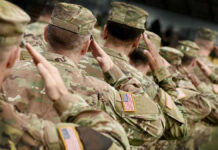
A divided nation just watched a federal court quietly decide who is “fit” to wear the uniform, and the ruling says far more about power, readiness, and rights than most headlines admit.
Story Snapshot
- A D.C. federal appeals court upheld the Trump administration’s ban on transgender individuals serving in the U.S. military.
- The court treated the policy as a military judgment about readiness, not as a blanket act of discrimination.
- The ruling exposes a deep clash between evolving gender politics and traditional views of military effectiveness.
- The decision may shape how far future presidents can go in setting social policy through military regulations.
The court ruling that kept a controversial ban alive
The U.S. Court of Appeals for the D.C. Circuit upheld the Trump administration’s policy restricting transgender Americans from serving openly in the armed forces, effectively accepting the government’s argument that the policy was grounded in professional military judgment rather than raw political hostility. The decision did not come from a stray lower court; it came from one of the nation’s most influential appellate benches, which often serves as a proving ground for issues destined for the Supreme Court.
Trump admin's ban on trans troops upheld in major court ruling https://t.co/hhmqklJ286 pic.twitter.com/zo3xOJWLC2
— American Military News (@AmerMilNews) December 11, 2025
The panel viewed the policy through the lens that courts historically use for military questions: deference. Judges have long hesitated to second-guess decisions about force structure, medical standards, and deployability. Supporters of the ruling argue that if every politically contentious personnel standard is treated as a civil-rights revolution waiting to happen, civilian courts risk micromanaging warfighting institutions. Critics respond that when a policy singles out a class of people based on gender identity, it should trigger rigorous constitutional scrutiny, not reflexive trust.
Readiness, cost, and the conservative case for tight standards
Military leaders and civilian defense officials under the Trump administration framed the policy as a question of readiness and cohesion, not identity. They raised concerns about service members who require ongoing, resource-intensive medical care, or whose treatment could limit deployability to austere environments. From a conservative standpoint, the core responsibility of the Pentagon is to deter and win wars, not to serve as a laboratory for rapidly shifting social norms or therapeutic commitments that complicate global deployments.
Supporters of the ban point to common-sense criteria the services already impose: strict rules on weight, fitness, chronic illness, and even minor medical conditions that can disqualify willing volunteers. They argue that if the country accepts tough, impersonal limits on diabetics or asthmatics, it is not bigotry to question whether gender-transition-related care—hormones, surgeries, follow-up treatments—poses similar or greater obstacles. Opponents counter that many transgender troops already serve honorably and deploy effectively, and that policy should rest on individual medical assessments rather than broad exclusions tied to identity labels.
Rights, identity, and the limits of social experimentation
Civil-liberties advocates cast the ruling as a regression, arguing that once individuals meet objective performance and health standards, their gender identity should be irrelevant. They see the policy as government endorsing a contested view of biology and identity through the blunt instrument of exclusion. From that angle, the decision signals to transgender Americans that their willingness to risk their lives is less valuable than political comfort in Washington, D.C., and within parts of the Pentagon bureaucracy.
Conservatives who support high standards but distrust bureaucracy see a different danger. When identity-based demands drive rapid policy swings from one administration to the next, the uniformed services risk becoming symbols in a larger culture war. That instability undermines trust inside the ranks, especially among career service members watching rules on uniforms, housing, and medical coverage change with each election. Stable, clearly justified standards—rooted in biology, mission, and merit—align more closely with traditional American military values than social experiments pushed on short timelines.
What this means for future presidents and the culture war over the military
The D.C. Circuit’s decision does more than address one administration’s policy; it sketches the boundaries of presidential power over military social rules. A future president could move to reverse the ban and expand open service again, but this ruling provides a legal playbook for any administration that wants to restrict service based on medical or psychological categories tied to identity. Courts that defer broadly today may defer just as broadly tomorrow, regardless of which ideology holds the White House.
The deeper question is what Americans expect the military to be. One vision treats the armed forces as a mirror of civilian society, obligated to embody every new understanding of identity. Another sees the military as a sharply limited institution with one purpose: prevailing in combat, with every policy judged first by that standard. This ruling did not settle that philosophical fight. It simply handed one round to a president who argued that when social theory collides with the requirements of war, the Constitution still allows the commander in chief to choose readiness first.
Sources:
Supreme Court Allows Trump’s Transgender Military Ban