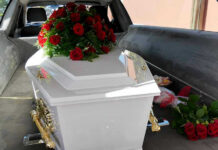
Two children can vanish in plain sight for months, even when their final hiding place sits steps from a public school.
Quick Take
- Police found two young girls’ remains inside separate suitcases in shallow graves near East 162nd Street and Midland Avenue in Cleveland, beside Ginn Academy.
- Preliminary DNA results said the girls were half-sisters, yet neither had been publicly identified at the time of reporting.
- Investigators said the remains appeared to have been there “some time,” not recently placed, complicating timelines and witness memory.
- Police reported no suspects and no leads at the time, while asking residents to share anything unusual they noticed.
A Dog Walk, a Suitcase, and a Neighborhood That Can’t Unsee It
A man walking his dog just after 6 p.m. triggered a horror-story reality near East 162nd Street and Midland Avenue in Cleveland: a suitcase in a shallow grave held a young girl’s remains. Officers searching the area found a second shallow grave nearby, also hiding a suitcase and a second girl. Cleveland police later said preliminary DNA results showed the victims were half-sisters, deepening the urgency and the questions.
Chief Dorothy Todd captured what residents feel but struggle to say: the trauma isn’t abstract when the scene sits outside your doorstep. Proximity to Ginn Academy sharpens that dread. A school signals routine—drop-offs, buses, sports practices—yet the location also offered cover. The case forces a grim recognition: familiar places can mask the unthinkable, and “safe” often means “unexamined” until something breaks the illusion.
What Investigators Know, and What They Still Don’t
Police provided age ranges instead of names: one child estimated around 8.5 to 13 years old, the other around 10.5 to 14. That gap between estimates and certainty matters because identification drives everything else—family connections, last-known locations, medical history, school enrollment, and the records that create investigative threads. Without names, detectives can’t easily reconstruct a timeline, and the public can’t recognize who they’re supposed to remember.
The most consequential detail may be the least cinematic: investigators said the remains had been there for “some time,” not recently placed. That suggests weeks or months of silence—less fresh physical evidence, fewer reliable witnesses, and more neighborhood routine to blur what once looked suspicious. A car that parked oddly in November becomes forgettable by spring. People replay their mental footage and realize they didn’t save the clip because they didn’t know it mattered.
The Half-Sister Detail Changes the Universe of Possibilities
Half-siblings share one biological parent, so detectives immediately face a narrower and more intimate map than with unrelated victims. That does not prove who harmed them, but it does steer the investigation toward shared custody arrangements, relatives, caregivers, and overlapping social circles where both children could have been present. The relationship also raises the stakes for locating the surviving parent, siblings, and any guardians who can confirm last contact and routines.
Common sense points to a painful truth about crimes against children: many originate inside a child’s orbit, not from a stranger in a dark alley. That doesn’t mean investigators should ignore outside suspects; it means they must pressure-test the closest explanations first. American conservative values emphasize family responsibility and community vigilance; this case challenges both. If these girls lived locally, someone—an adult, a neighbor, a school contact—may have noticed absence, bruises, fear, or sudden moves.
“No Threat to the Public” Isn’t the Same as “Nothing to Fear”
Authorities said they had no reason to believe there was a known threat to the public. People hear that and want relief, but the phrase carries a narrower meaning: police may see no pattern suggesting random attacks. It does not answer the question every parent asks: how did two children end up concealed near a school without alarms going off? The real safety lesson is less about panic and more about attention.
Attention sounds soft until you measure it against time. If the remains sat there for an extended period, then prevention did not fail in one dramatic moment; it failed quietly, repeatedly. The area didn’t necessarily lack good people—it lacked actionable signals reaching the right hands. Tips matter: an unfamiliar adult frequently near a vacant lot, repeated late-night digging sounds, a vehicle stopping routinely, a child suddenly missing from school life. Investigators need specifics, not theories.
Why Community Memory Becomes Evidence
Police said they had no suspects and no leads at the time of reporting, while working with federal, state, and local partners. That posture often looks like “nothing is happening,” but it can also reflect disciplined restraint while evidence gets processed. Still, when a case depends on identification and time has passed, the public becomes a living archive. One person’s odd detail—“I saw someone hauling a suitcase”—can connect to a date, a camera, a receipt, a location ping.
The biggest open loop remains the simplest: who were these girls, and who last had them? Once identities become known, investigators can test attendance records, custody documents, medical visits, and prior police calls. The public can also stop searching their minds for faceless victims and start remembering two real children. That shift changes a case. Names turn tragedy into accountability, and accountability is the only thing that can pull a community out of the fog.
Who would do this?😡😢
Girls Found Dead in Suitcases Were Half-Sisters; Person of Interest Questioned https://t.co/y3EpuJJuoI via @crimeonlinenews— Silver Sleuth (@SilverSleuthh) March 5, 2026
Until then, the neighborhood near Ginn Academy lives with a contradiction: police say no public threat, yet two children lay hidden nearby long enough for grass to grow back. That gap should not inspire paranoia; it should inspire the kind of old-fashioned, conservative-minded civic seriousness that protects kids—report what you see, demand competent follow-through, and refuse to let “someone else’s problem” become a shallow grave.
Sources:
2 half-sisters found dead in suitcases in Cleveland, police say