Nine deaths outside a U.S. consulate in Karachi exposed how one foreign strike can light a fuse across Pakistan faster than any government can stamp it out.
Story Snapshot
- U.S. and Israeli airstrikes killed Iran’s Supreme Leader Ayatollah Ali Khamenei, triggering intense grief and rage well beyond Iran’s borders.
- Pro-Iran demonstrations erupted across Pakistan, with the deadliest violence at the U.S. Consulate in Karachi after protesters breached an outer wall.
- Hospitals reported at least nine fatalities from gunshot wounds and more than 30 injuries; reporting also noted uncertainty about who fired the fatal shots.
- Pakistan’s leadership condemned the killing as a violation of international law while also ordering investigations into deaths during the clashes.
Karachi’s consulate becomes the pressure point
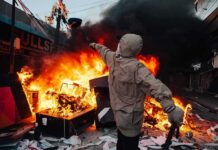
Hundreds of protesters converged on the U.S. Consulate in Karachi after news spread that Khamenei had been killed in U.S.-Israeli strikes. The crowd breached the compound’s outer wall and pushed toward the building as police tried to hold lines with tear gas and gunfire. Vehicles burned nearby, streets choked, and the situation turned into a casualty event: at least nine dead and more than 30 injured, with gunshot wounds reported among the fatalities.
Diplomatic facilities attract crowds for a simple reason: they symbolize a foreign decision that locals cannot vote on, lobby, or appeal. That dynamic gets volatile when people feel both powerless and personally invested. Pakistan’s Shiite communities, concentrated in cities like Karachi and in regions such as Gilgit-Baltistan, often react strongly to events touching Iran’s clerical leadership. Once a protest moves from mourning to “make them pay,” security forces face an ugly menu of options.
Why Pakistan erupts when Iran bleeds
Pakistan sits on a geopolitical fault line: it hosts deep religious ties to Iran among many Shiites, relies on internal stability to keep its economy functioning, and still must manage an often-strained partnership with the United States. Khamenei’s killing punched all three nerves at once. Demonstrations spread beyond Karachi to Lahore, Islamabad, and Skardu, showing coordination and fast mobilization. Roads into Islamabad’s red zone were blocked, a tell that authorities feared copycat pressure on embassies and parliament.
The protests also widened their aim. A U.N. office building in Skardu was stormed and set on fire, and nearby vehicles burned. That detail matters because it suggests the outrage did not stay neatly targeted at a single government; it spilled into generalized anti-Western anger and an appetite for visible, televised confrontation. A conservative, common-sense read of this pattern says the same thing it always says: when mobs feel rewarded by attention, they escalate to bigger symbols.
Gunfire ambiguity and the credibility trap
Reports described fatalities from gunshot wounds while also acknowledging uncertainty over who fired the shots. That ambiguity is not a minor footnote; it is the matchbox for future unrest. If police fired, the state risks creating martyrs and a recruitment narrative. If provocateurs or armed elements fired from within the crowd, Pakistan faces a darker problem: organized militants using street grief as cover. Either way, governments lose legitimacy when they cannot quickly establish clear facts the public can trust.
Sindh’s chief minister ordered a transparent and impartial investigation, which is the correct move in principle and a hard one in practice. “Transparent” requires evidence preservation, credible ballistics, clean chain-of-custody, and a willingness to publish uncomfortable findings. Pakistan’s authorities must also protect diplomatic sites as a baseline duty under international norms. A state that cannot secure consulates invites more attacks, higher insurance costs, and foreign policy isolation that ordinary citizens end up paying for.
What Shehbaz Sharif signaled to both sides
Prime Minister Shehbaz Sharif publicly framed Khamenei’s killing as a violation of international law and expressed solidarity with Iranians in grief. That statement served two audiences at once: domestically, it recognized genuine communal mourning and tried to drain anger away from Pakistan’s own leadership; internationally, it positioned Pakistan as condemning the strike without explicitly endorsing violence. Conservatives tend to respect moral clarity, but clarity also requires insisting that rage does not justify attacking consulates or torching U.N. offices.
U.S. and British advisories urging caution underline the second-order consequence: once a single post becomes a battleground, every Western-linked facility turns into a perceived pressure valve. That raises the security burden across an entire country, not just one city. For Pakistan, the nightmare scenario is a rolling cycle: a geopolitical trigger, street mobilization, deaths with disputed responsibility, then retaliatory rumors that pull more people out the next day.
The regional message: escalation travels faster than diplomacy
Pakistan was not alone; protests also flared in Iraq, another country with substantial Shiite populations and long experience absorbing U.S.-Iran shocks. The broader point lands with a thud: targeted killings and airstrikes at the top of Iran’s leadership do not stay “over there.” They generate street-level consequences in places with young populations, polarized media ecosystems, and fragile security bandwidth. Once crowds test a wall and see it bend, they come back believing it can break.
At least 10 killed in Pakistan as pro-Iran protesters clash with police after Iran's Supreme Leader killedhttps://t.co/WO8Jhyn954
— Human Events (@HumanEvents) March 1, 2026
Pakistan now faces a simple but brutal governance test: enforce order around diplomatic facilities without turning enforcement into a propaganda gift for extremists. That means disciplined rules of engagement, rapid and public fact-finding about who fired, and zero tolerance for arson and breaches. The U.S., for its part, will read Karachi’s breached perimeter as a warning about exposure across the region. When leaders trade strikes, middle countries absorb the sparks—and Karachi just proved how lethal those sparks can get.
Sources:
Protests Break Out in Pakistan, Iraq Over Khamenei’s Death; 9 Die in Karachi
9 killed in pro-Iran protest at US consulate in Pakistan’s Karachi