
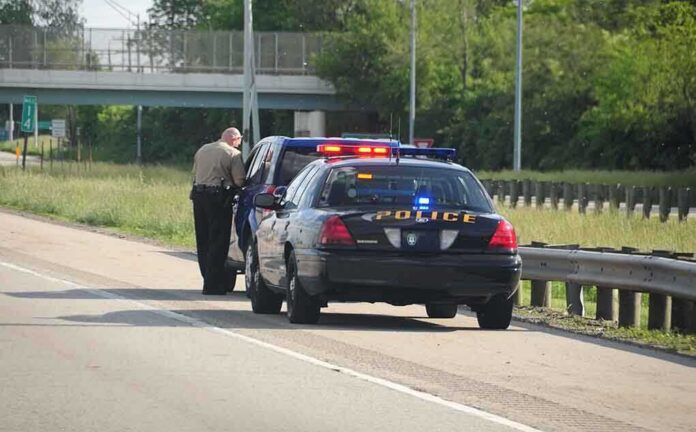
President Trump just turned a quiet internal pause on ICE traffic stops into a public showdown over who calls the shots when immigration enforcement collides with deadly force.
Story Snapshot
- ICE ordered to suspend most vehicle stops nationwide after two fatal shootings tied to traffic stops.
- Trump publicly blasted the pause and told ICE to keep using traffic stops as a key crime-fighting tool.
- The clash exposes deep tension between safety concerns, legal limits, and Trump’s mass deportation agenda.
- Americans now face a hard question: how far should federal agents go on our roads in the name of security?
ICE traffic stops paused after two deadly shootings
Immigration and Customs Enforcement ordered officers to suspend most vehicle stops this week after two men were shot and killed in separate traffic-stop encounters, one in Houston and one in Biddeford, Maine. The directive applied across the country to agents in Enforcement and Removal Operations, the division that arrests and deports immigrants. Officials left a narrow exception for cases involving serious criminal warrants or when agents worked directly with local police on targeted suspects.
This pause marked a sharp turn for an agency that has leaned heavily on vehicle stops during Trump’s second term. Federal reports describe immigration agents breaking car windows, dragging people from vehicles, and using escalating force in street operations, with several people shot and five killed in recent years during enforcement actions. After the latest deaths, pressure came fast from lawmakers in Maine and Texas and from inside the Department of Homeland Security to pull ICE officers back from routine traffic encounters.
Trump blasts the stand-down and urges ICE to resume stops
President Trump did not wait for a formal briefing before responding. On Truth Social, he praised ICE officers and told them they “cannot give up one of ICE’s most important and effective crime fighting tools, THE TRAFFIC STOP!” He claimed crime is “way down” and argued that aggressive enforcement, including traffic stops, is helping clean up criminals he says entered under the previous Democratic administration. He framed the pause as “playing right into the criminals’ hands” and vowed it would not stand.
Trump’s message directly undercut the suspension that Homeland Security and ICE leadership had just ordered. According to reporting on the internal guidance, agents had been told to stop initiating vehicle stops on their own and instead rely on partner agencies when they needed to arrest someone in a car. Trump’s post signaled to officers on the ground that the President wants them back on highways and city streets, treating traffic stops as a front-line tool in his broader mass deportation push.
Legal limits, deadly force, and racial profiling concerns
Federal law places real limits on what immigration agents can do during traffic stops. They cannot pull someone over for a broken taillight the way local police can. To stop a vehicle, an ICE officer must suspect a federal crime or an immigration violation and be able to explain that suspicion. Courts have also warned agents against relying only on race, language, or where someone works, though the Trump administration has pressed hard on those boundaries.
The Supreme Court recently allowed ICE in Los Angeles to treat race, Spanish language use, and certain jobs as part of “reasonable suspicion” for roving patrols. That decision shocked civil liberties advocates, who say it opens the door to blatant profiling, especially of Latinos. An investigation in New York and New Jersey found that about 93 percent of ICE arrests in a major sweep targeted people from Latin American countries, fueling public anger that enforcement has crossed from security into harassment.
A familiar pattern in Trump’s immigration crackdown
This clash over traffic stops fits a pattern that has repeated under Trump. The administration pushes aggressive tactics, then pulls back only when there is a crisis: a court ruling, a shocking video, or in this case, dead civilians on the road. Trump expanded raids, created Homeland Security task forces in every state, and shifted enforcement deep into interior cities rather than the border, all funded with tens of billions of extra dollars for detention and deportation.
🚨BREAKING: President Trump has called for ICE to resume traffic stops, overriding Homeland Security Secretary Markwayne Mullin's pause on the tactic ordered Tuesday following two fatal shootings by ICE agents in Texas and Maine.
"We CANNOT give up one of ICE's most important… pic.twitter.com/Z5cDnCOsiB
— Off The Press (@OffThePress1) July 15, 2026
At the same time, ICE has quietly stripped away paperwork requirements and guardrails that once slowed officers and forced them to justify arrests. That combination—more power, fewer checks—has led to abuses, criminal charges against some agents, and growing fear in immigrant neighborhoods. A national poll recently found about two-thirds of Americans now believe ICE has “gone too far” in how it conducts immigration enforcement, even among voters who still want strong borders.
What this showdown means for common-sense enforcement
Trump’s supporters argue that traffic stops are basic law enforcement and that dangerous people will slip through if ICE backs off. That view lines up with conservative values about law, order, and holding the line against crime. If someone is driving without a license and has a serious record, they say, why should an immigration officer ignore it. From that angle, the traffic-stop pause looks like political overreaction that ties the hands of those trying to keep communities safe.
The facts, though, show that without tight rules and real accountability, vehicle stops can turn into fast-moving, deadly encounters. When agents feel shielded from consequences and can rely on race or language as “factors,” innocent people will get caught up, and some will get hurt. Common sense says Americans can back strong enforcement while still demanding that federal officers respect the Constitution, use force only when it is truly needed, and answer for mistakes. The current fight over ICE traffic stops is where that line is being tested in real time.
Sources:
redstate.com, nytimes.com, stateline.org, audacy.com, yahoo.com, aol.com, americanimmigrationcouncil.org, nbcnews.com, abcnews.com, npr.org
© featuredheadlines.com 2026. All rights reserved.