
Trump just turned a sleepy election agency into the latest battlefield over who gets to decide who votes.
Story Snapshot
- Trump fired every remaining member of the Election Assistance Commission months before the 2026 midterms.
- The White House points to a new Supreme Court decision and says it is about securing elections and stopping illegal voting.
- Critics say the law protects commissioners from removal without cause and warn this is political interference in how America votes.
- The real fight is over one key change: adding hard proof of citizenship to the national voter registration form.
Trump’s sudden purge at the election commission
President Donald Trump fired all remaining members of the Election Assistance Commission, including Democrats Thomas Hicks and Benjamin Hovland and Republican Christy McCormick, leaving the agency with no commissioners at all. The commission is a small federal body most voters have never heard of, but it quietly helps states run elections and sets rules for the federal voter registration form used for national races. The firings came less than four months before the 2026 midterm elections, which put the timing front and center.
The White House framed the move as part of a push to secure America’s elections and make sure every legal vote is counted, tying it directly to voter integrity and fraud concerns. A statement said Trump reserves the right to remove people who are not fully aligned with that mission, signaling that loyalty to his view of election security now matters as much as technical skill. To many conservatives, that sounds like finally taking federal election help seriously instead of leaving it to career bureaucrats and activists.
The Supreme Court ruling that opened the door
The firings did not happen in a vacuum. They followed a Supreme Court decision, often called the Slaughter case, that greatly expanded presidential power to remove officials at independent federal agencies. Reporting described Trump’s action at the Election Assistance Commission as his first big test of that new authority, almost a live experiment in how far a president can go when Congress says an agency is supposed to be independent. The White House leaned on that ruling when it justified the purge, arguing the president now has broad removal power over most federal boards.
Legal watchdogs see it differently. The Campaign Legal Center and other groups point out that Congress specifically designed the Election Assistance Commission as an independent agency where commissioners cannot be removed without cause, and they argue Trump is trampling those limits. Their view is simple: the Supreme Court strengthened the president’s hand, but it did not erase every statutory protection Congress ever passed. For Americans who worry about concentrated federal power, this clash matters far beyond one small commission.
The hidden prize: the national voter registration form
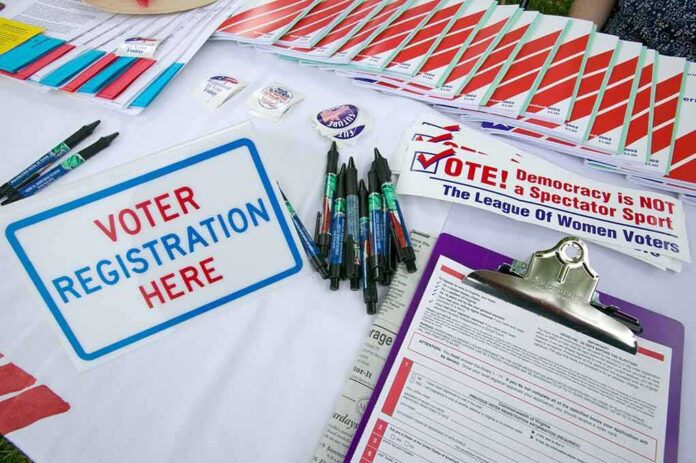
So why target this agency at all? One answer sits in a dry but powerful document: the federal voter registration form. That single form is used nationwide for federal elections and is set by the Election Assistance Commission. Legal expert Rick Hasen explains that Trump wants to change that form so it requires documentary proof of citizenship, such as a passport or birth certificate, before someone can register to vote in federal contests. That change would reshape how millions of Americans sign up to vote.
Federal courts have blocked past efforts to force that kind of citizenship proof through the commission, ruling that the president does not have the authority to order such a change on his own. That history fuels critics who say the firings are a strategic move to clear out people who might resist the mandate and replace them with loyalists willing to approve it. From a conservative common-sense lens, the core idea is straightforward: only citizens should vote, and requiring evidence of citizenship is hardly extreme. The legal question is whether the president can muscle that requirement in through an “independent” agency.
What the Election Assistance Commission actually does
The Election Assistance Commission was created in 2002 after the messy 2000 presidential recount, with a simple job list: help states run better elections, certify voting machines, provide funding and advice, and maintain the national voter registration form. It does not investigate fraud and does not prosecute crimes. That role belongs to the Department of Justice and to state officials. Even some critics admit the immediate impact on the 2026 midterms is likely small, because enforcement of election laws lies elsewhere.
TRUMP REMOVES DEMOCRATIC ELECTION COMMISSION MEMBERS — A DIRECT RESULT OF THE SUPREME COURT’S EXPANDED VIEW OF PRESIDENTIAL FIRING POWER
President Trump has removed the two Democratic members of the U.S. Election Assistance Commission (EAC), the federal agency responsible for… pic.twitter.com/rutUNLXUS8
— NewsTreason Channel 17 (@NewsTreason) July 10, 2026
Still, removing all the commissioners turns the agency into a shell right when states rely on it for guidance and technology checks. Bipartisan leadership, with both parties represented, was meant to give voters confidence that federal help on elections was not a partisan trick. When Trump fires everyone and leaves empty chairs, the practical work slows and the symbolic balance collapses. Supporters answer that many of these commissions have drifted left over time and that clearing them out is the only way to reset them.
A broader pattern of taking control of independent boards
This episode fits a larger pattern from Trump’s second term. Since 2025, he has fired or tried to fire dozens of members from many federal boards that were supposed to enjoy some independence and “for cause” protection. Analysts describe an unprecedented push to pull those bodies closer to direct presidential control, from elections to environmental rules. To some Americans, that looks like long overdue accountability for unelected insiders; to others, it looks like one man grabbing the steering wheel of government.
Media outlets and legal think tanks frame the Election Assistance Commission purge as part of a wider attack on elections, pointing to Trump’s past claims of widespread fraud and his hostility to mail-in voting. They warn that firing bipartisan commissioners right before national elections sends a clear message: norms are out, raw power is in. A sober conservative reading of the facts sees both risk and opportunity. Cleaning out entrenched commissions can protect voters if handled by serious adults focused on integrity. Doing it fast, in the heat of campaign season, without transparent standards, invites chaos and mistrust that undercuts the very confidence it claims to defend.
Sources:
redstate.com, democracydocket.com, notus.org, aa.com.tr, instagram.com, nytimes.com, facebook.com
© featuredheadlines.com 2026. All rights reserved.