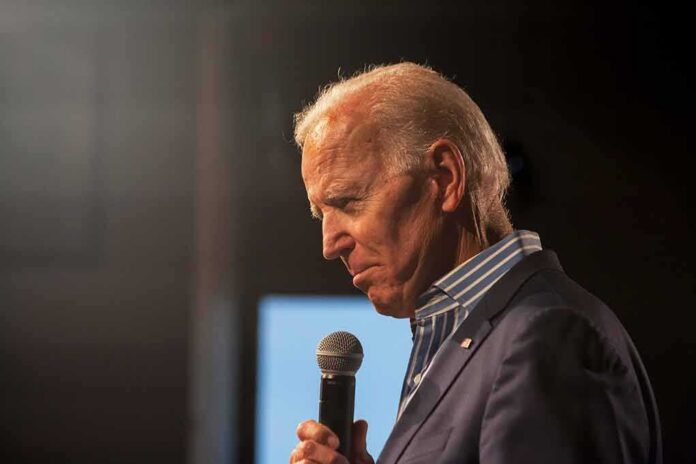
A federal appeals court just told Joe Biden no, again, refusing to shield his private tapes from public release.
Story Snapshot
- The D.C. Circuit Court of Appeals denied Biden’s request to block release of audio recordings and transcripts tied to his ghostwriter interviews.
- The recordings came from a criminal probe into Biden’s handling of classified documents, led by Special Counsel Robert Hur.
- The Justice Department plans to hand the material over to the Heritage Foundation and the House Judiciary Committee.
- A lower court judge already ruled that public interest outweighs Biden’s privacy claims.
The Fight Over Biden’s Private Recordings
Joe Biden sat down for hours of taped conversations with his ghostwriter, Mark Zwonitzer, while writing his memoir. Those recordings later became evidence in Special Counsel Robert Hur’s investigation into classified documents found at Biden’s home and office. Hur’s team cleared Biden of criminal charges, but the tapes stuck around as government records, subject to public records requests once the case closed.
The Heritage Foundation, a conservative think tank, filed a Freedom of Information Act request for the material. The House Judiciary Committee wanted it too. Biden’s lawyers fought back hard, arguing the conversations were “never intended to be shared with a wider audience” and existed in government hands only because of a criminal probe that led nowhere.
Judge Rejects Biden’s Privacy Argument
U.S. District Judge Dabney Friedrich, appointed by President Trump, heard Biden’s case first. She rejected his bid for a preliminary injunction, ruling that the public’s interest in seeing the recordings outweighed whatever privacy rights Biden still holds as a private citizen. Biden no longer serves in office and isn’t seeking any, a fact that weakened his privacy claim considerably in the court’s eyes.
Friedrich did grant Biden a short window to appeal before the Justice Department had to release anything. That set up the next round: Biden’s team rushed to the D.C. Circuit Court of Appeals, hoping three judges would see things differently than Friedrich had.
The Appeals Court Extends, Then Denies
At first, the D.C. Circuit gave Biden a temporary reprieve. A three-judge panel paused the lower court’s order so it could weigh whether to grant a longer injunction while the appeal played out. That pause bought Biden’s team a little more time and a lot of headlines suggesting the fight was far from over.
It didn’t last. The appeals court ultimately denied Biden’s request for a stay pending appeal, ruling that his lawyers had not met the “stringent requirements” the law demands for blocking a lower court’s order. Citing the Supreme Court precedent Nken v. Holder, the panel found Biden hadn’t shown he would suffer irreparable harm if the tapes came out. The court did stay its own opinion until August 3 to give Biden one last shot at a higher appeal, but the writing is on the wall.
Why Courts Keep Siding With Disclosure
This case fits a pattern that shows up again and again when former presidents try to keep records under wraps. Courts routinely lean toward disclosure when the records connect to a government investigation, even one that closed without charges. Personal privacy claims tend to lose out once a president leaves office and the records touch on official conduct rather than purely private life, and that principle held firm here.
For conservatives who’ve watched years of stonewalling over classified documents, special counsel findings, and executive privilege claims, this ruling lands as simple accountability. A sitting government official recorded conversations that became evidence in a federal investigation, and now the public gets to see what those tapes actually contain. No special treatment, no shield of privacy strong enough to override the public’s right to know how its former commander in chief handled sensitive material.
The Justice Department still has to finish redacting sensitive portions before handing anything to Heritage Foundation or House Judiciary Committee investigators. But barring a last-minute Supreme Court intervention, the tapes are coming out. Karma, as the saying goes, tends to arrive on its own schedule.
Sources:
twitchy.com, cbsnews.com, njsr.com.ng, youtube.com, protectdemocracy.org, govinfo.gov, thehill.com
© featuredheadlines.com 2026. All rights reserved.