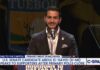
President Trump wasted no time turning Abdul El-Sayed’s Michigan primary win into a national fight over Israel, ideology, and the limits of progressive politics.
Quick Take
- Trump attacked El-Sayed within hours of his Michigan Democratic Senate primary victory.
- He called El-Sayed a “communist,” a “man of hate,” and accused him of hating Jews and Israel.
- El-Sayed answered by saying he opposes unconditional military aid and wants more focus on health care and costs.
- The clash highlights how quickly a primary win can become a larger culture war over Israel and the left.
Trump’s Attack Landed Fast
Trump’s criticism came almost immediately after El-Sayed secured the Democratic nomination in Michigan’s Senate race. Reporting from Time, Bloomberg, and Politico shows Trump using a Las Vegas speech and a Truth Social post to call El-Sayed a “communist,” a “man of hate,” and someone who hates Jews and Israel. NBC News also reported that El-Sayed’s win gave progressive Democrats a major foothold in a key battleground state.
Trump’s language was not subtle. He moved from political attack to personal insult, and then to a charge that El-Sayed was hostile to Jewish people. That made the clash about more than one Senate race. It became a test of whether a progressive candidate can survive being cast as a threat to Israel, business interests, and basic civic decency all at once.
What El-Sayed Actually Said
The record behind Trump’s attack is rooted in El-Sayed’s own public positions. He has said he opposes unconditional military aid to Israel and other countries, and he wants federal money redirected to health care, schools, and roads. He also said, “I want to get money out of politics, put money in your pocket, and pass Medicare for All,” which explains why critics portray him as far left.
El-Sayed has also been blunt about Israel. Coverage from CBS and Time says he criticized Israeli policy with unusually hard language, including claims about genocide and apartheid in some interviews and appearances. He has denied antisemitic intent and said his concern for Jewish safety is personal and serious. His camp argues that Trump is attacking his policy views, not proving prejudice.
Why the Fight Matters Beyond Michigan
This dispute fits a pattern that has become familiar in modern politics. Progressive candidates who challenge military aid to Israel, reject corporate money, or embrace Medicare for All often become easy targets for labels like “socialist” or “communist.” In this case, Trump’s attack also follows his usual style: a fast, loud, and deeply personal assault that mixes policy criticism with moral judgment and barely stops to separate the two.
That approach can work on his supporters because it gives them a simple story. El-Sayed looks like a left-wing nominee with strong views on money, health care, and foreign policy. Trump then presents those views as proof of extremism. The gap between policy disagreement and character attack is where the political damage happens. For swing voters, that gap can decide whether the race feels serious or just toxic.
The Limits of Trump’s Case
Trump’s sharpest claims go beyond the public record. The reporting does not provide evidence that El-Sayed hates Jews, and it does not show any communist affiliation beyond Trump’s label. Politico also noted that Trump’s allegations of voter fraud in Wayne County were made without evidence. That matters, because the strongest documented case against El-Sayed is not criminal or conspiratorial. It is ideological.
Dr. Abdul El-Sayed has publicly criticized Mike Rogers, accusing him of being closely aligned with major corporate interests and former President Donald Trump. The remarks are part of ongoing political debate ahead of future elections. #Politics #USPolitics #Michigan https://t.co/eNZuHhTlmV
— The Workers Rights (@theworkersright) August 7, 2026
That distinction gives El-Sayed a usable defense. He can argue that he is anti-war, pro-human-rights, and focused on affordability, while Trump is lashing out because the nominee does not fit a conventional Democratic mold. Whether voters accept that defense will depend less on the heat of the attack than on which part of the story they remember: the insult, or the policy debate underneath it.
Sources:
facebook.com, youtube.com, c-span.org, aljazeera.com, politico.com
© featuredheadlines.com 2026. All rights reserved.