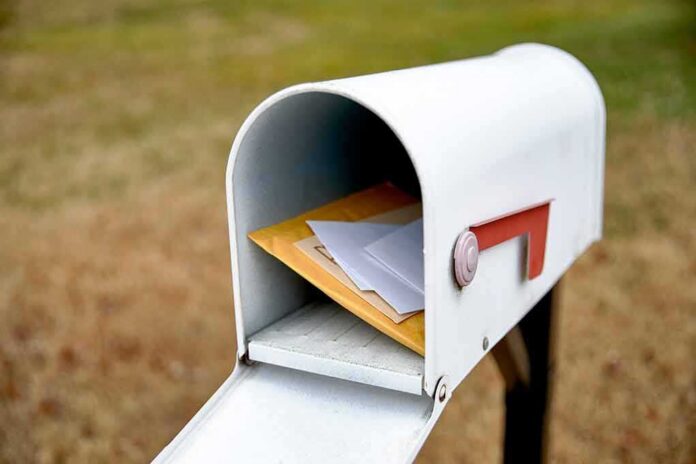
A California man was caught using a homemade trap to steal mail and unvoted ballot packets from a Scottsdale post office, handing voters a real-world look at how election security can rise or fall on something as simple as a blue collection box.
Story Snapshot
- Postal inspectors say they watched Richard Ramos Jr. pull mail from a USPS box using cardboard traps.
- Recovered items reportedly included checks worth thousands of dollars and three Maricopa County ballot packets.
- County officials say the ballots were unvoted outbound packets, not completed votes, and they reissued them to voters.
- The case shows how ordinary mail theft can cross the line into an election security problem without warning.
A cardboard trap, a blue box, and a felony arrest
According to local reporting, United States Postal Inspectors in Scottsdale say they saw 26-year-old Richard Anthony Ramos Jr., from Stockton, California, stuff cardboard pieces into a blue United States Postal Service collection box outside the Scottsdale Hopi Post Office. Those cardboard pieces allegedly formed a trap that caught outgoing mail before it dropped to the bottom of the box. Inspectors then say they watched Ramos reach back in and pull mail out of the bin, turning an everyday public mailbox into his personal grab bag.
Postal inspectors moved in and arrested Ramos at that Scottsdale Hopi Post Office on July 21, after the surveillance operation caught him in the act. Court records described by the station say prosecutors charged him with two counts of third-degree burglary and one count of aggravated identity theft. That charging mix tells you how law enforcement saw the case: not as a prank or a petty grab, but as a serious breach of both property rights and personal information. Burglarizing a federal mail receptacle and misusing identities is squarely in felony territory.
What they found in the car, and why it matters
After the arrest, postal inspectors searched Ramos’s vehicle. The report says he signed a consent form from the United States Postal Inspection Service, allowing the search. Inside, investigators reportedly found United States Postal Service Priority boxes, his cell phone, and a stack of stolen mail. Among that mail, inspectors say they recovered checks worth thousands of dollars and three Maricopa County mail-in election ballot packets. Now the story moves from “stolen mail” to “stolen election materials,” and that line is where public concern spikes, especially for voters who already worry their ballot might vanish between the kitchen table and the counting room.
The presence of those checks matters a lot for understanding motive. If someone targets mailboxes for checks, gift cards, and personal data, that is a classic mail theft scheme. When ballot packets show up inside that pile, it raises a tougher question: was he aiming for ballots, or did he grab anything that looked valuable and ballots came along for the ride? The available record here leans toward a broad theft scheme, not a specific ballot hunting mission. That detail aligns with common sense and conservative values: motive matters when we talk about election crime, because we do not want to inflate or downplay real threats.
Ballot packets, not stolen votes, and how the county responded
The Maricopa County Recorder’s Office stepped in to explain exactly what kind of ballot-related material inspectors found. A spokesperson told the station that the seized items were “unvoted yellow carrier envelopes” and made clear these were outbound ballot packets that had not yet been filled out. In other words, these were blank ballot packets going from the county to voters, not completed ballots coming back with votes already marked. That distinction matters more than any headline. Stealing blank packets is serious, but it is not the same as changing votes already cast.
ICYMI: @abc15 has learned election ballots and checks worth thousands were among the mail stolen from a Scottsdale post office box in July.
Maricopa County Officials confirm the ballots were unvoted, blank packets, not completed votes.https://t.co/iTR3QCwQ4q
— Ford Hatchett (@FordHatchett) August 2, 2026
County staff documented receipt of those envelopes from the postal inspector and brought them directly to the Maricopa County Tabulation and Election Center. The Recorder’s Office then promptly reissued outbound ballot packets to the specific voters tied to those stolen envelopes. That response shows a basic but important safeguard: when someone interferes with election mail, officials can track who was affected and send replacement materials. For voters, it shows that the system has a way to patch a hole, even when crime tries to punch through the side of the process.
Mail theft, election integrity, and a bigger pattern in Maricopa County
This Arizona case lands in a county that has become a symbol in national election fights. In recent years, stories from Maricopa County have ranged from controversial ballot audits to a temporary election worker stealing a ballot tabulator key fob, forcing the county to reprogram machines and redo tests on the tabulators. In that separate incident, officials said they spent about $19,000 reprogramming equipment after a worker took the key fob from the election headquarters. Voters in the county have seen one security scare after another, even when final counts stay intact.
Each of these events shows the same tension. On one side, basic systems work: law enforcement responds fast, ballots are reissued, machines are reprogrammed, and official counts hold up under audits. On the other side, every theft, every missing key, and every stolen ballot packet feeds a narrative that the system is fragile. That narrative matters deeply to conservatives who argue for strong election integrity measures. They want strict policies, harsh penalties for interference, and tight control of access to ballots and tabulators, because they see each breach as proof that good safeguards are not “paranoia” but a necessary layer of protection.
Common sense takeaways for voters watching from the sidelines
Voters do not need a law degree to absorb the lessons here. First, crime does not need a grand political plan to hit elections; a man looking for checks can still disrupt ballot delivery when he raids a mailbox. Second, even “small” thefts can become an election story the moment ballot packets show up inside a pile of stolen mail. Third, clear facts are your best friend: this case involves outbound unvoted packets, not stolen completed ballots, and officials had a process to fix the harm.
From a conservative, common sense view, this is exactly why strong enforcement and fast transparency matter. When law enforcement and election officials move quickly, explain the facts, and repair damage, they protect not just the vote but public trust. When they slow-walk details or play down incidents, people rightly suspect more is wrong. The Ramos case reminds us that election integrity lives at street level too, in the quiet hum of a blue mailbox outside a neighborhood post office.
Sources:
thegatewaypundit.com, phoenixnewtimes.com, yahoo.com, votebeat.org
© featuredheadlines.com 2026. All rights reserved.