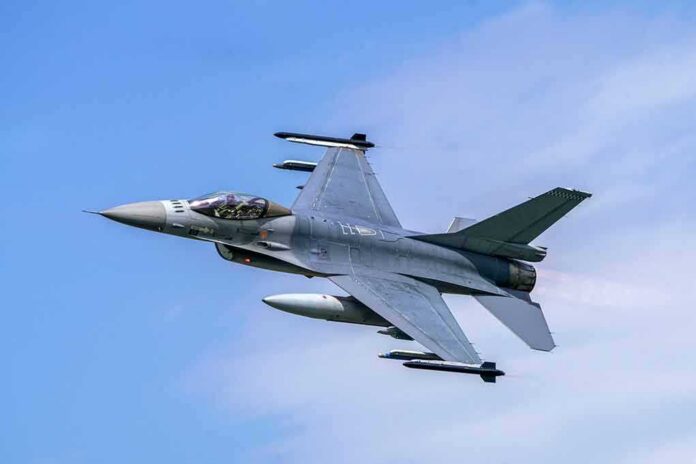
A Texas Air National Guard F-16 crashed in northern Michigan, and the pilot walked away alive.
Story Snapshot
- Texas Air National Guard jet went down during a training mission from Alpena.
- Pilot ejected, survived, and is in stable condition under medical care.
- Authorities set a one-mile evacuation zone after the crash.
- No other injuries were reported by Michigan State Police.
Training Flight Ends In A Sudden Ejection
Texas Military Department officials said a 149th Fighter Wing F-16 Fighting Falcon was on a routine training mission from the Air National Guard’s Combat Readiness Training Center in Alpena when it experienced an in-flight incident. The jet went down in Grand Traverse County, near Green Lake Township, early in the afternoon. The pilot ejected, survived, and received treatment at a nearby hospital, where condition updates listed stable and alert. Investigators have not released the cause, and the inquiry is underway.
Local responders moved fast. Dispatch logs and a press briefing placed the first calls just before 2 p.m., and units converged near 633 and Jethro Road in Green Lake Township. Emergency crews secured the site, checked for fire spread, and coordinated with military officials. The early emphasis focused on life safety for the pilot and anyone on the ground. Command staff then shifted to perimeter control and hazardous-material precautions as the scene developed.
Evacuation, Hazards, And What Did Not Happen
Michigan State Police directed an evacuation within a one-mile radius. Officials cited a hazardous chemical risk linked to the crash, a standard step with military fuel and ordnance concerns until teams can test and clear the area. The order covered homes and businesses to keep people away from potential toxins and debris. Police also reported no other injuries. That matters. In a rural crash footprint with homes nearby, zero reported civilian injuries is a rare good outcome.
Reporters on deadline juggled place names, with some early mentions of nearby townships. The central facts held steady across outlets: Texas unit, F-16, training mission, safe ejection, and an ongoing investigation. That match across networks signals confidence in the base narrative. The cause will come later, as it should. Military safety probes take time because they pull data from maintenance logs, flight records, and wreckage analysis to prevent the next mishap, not just describe this one.
How The Air Force Builds The Why
Air Force accident boards run legal fact-finding investigations that preserve evidence for claims and discipline and publish a releasable report when complete. Recent F-16 cases show how specific these findings can get. One report tied a crash to a faulty engine assembly. Another flagged a maintenance blind spot that hid damage inside an engine. These are the kinds of hard, mechanical truths that come from teardown, not from guesswork on day one.
The F-16’s long service life includes a known, trackable mishap history. Class A accidents, the most serious, have been studied for decades. A classic review found 190 such mishaps over 19 years, at a rate above the wider Air Force average for that era. Today’s rates are far lower than in the early years, but not zero. Modern training still carries risk, which is why egress seats, rescue coordination, and evacuation playbooks exist and saved lives here.
What Matters Next For The Community
Residents want to know two things: are they safe, and who pays for damage. The one-mile evacuation shows authorities treated safety as the first priority, and early checks found no added injuries. Cleanup and assessment typically follow, with military, state, and local agencies coordinating site work and public updates. Property claims and environmental reviews often track with the release of the official report, which documents sequence, cause, and responsibility in plain terms.
F-16 crash details in Michigan: toxic exposure, possible bird strike https://t.co/PzPzEF49ay
— The Detroit News (@detroitnews) September 18, 2026
Common sense says praise what worked here. Training builds muscle memory for the worst day, and it showed. A pilot executed the ejection system as designed. First responders locked down the scene and protected neighbors. Media shared verified basics, not rumors. The investigation will sort cause and accountability. Until then, the facts stand: a Texas F-16 crashed during a Michigan training sortie, the pilot lived, the public was protected, and a careful safety process is now in motion.
Sources:
feedpress.me, abcnews.com, chron.com, cbsnews.com, stripes.com, thehill.com, cninnews.blogspot.com, youtube.com, mediaite.com, afjag.af.mil, eielson.af.mil, safety.af.mil, airforcetimes.com
© featuredheadlines.com 2026. All rights reserved.