
A burst tire and brutal shaking tore cabin panels loose, yet everyone walked away.
Story Snapshot
- A Sepehran Airlines Boeing 737 returned to Mashhad after takeoff due to a tire failure and engine issue.
- Passengers filmed violent shaking and falling interior panels; the jet landed safely with no injuries.
- The flight was bound for Kermanshah and turned back minutes after departure.
- Tire debris can damage engines, a known hazard documented in past cases.
A violent climb, a fast turnback, and a safe landing
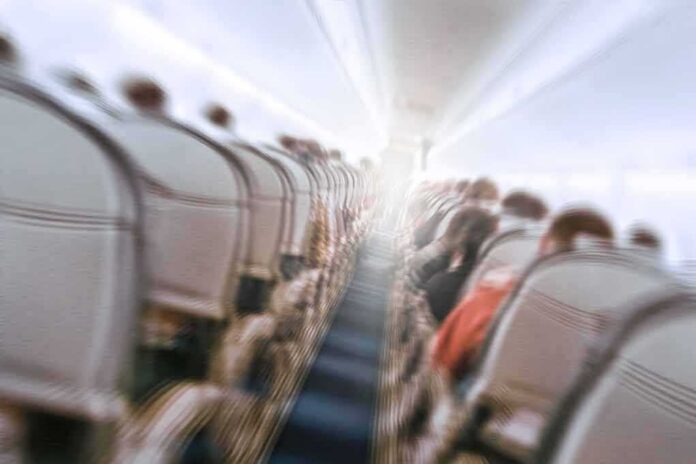
Sepehran Airlines launched a Boeing 737 from Mashhad toward Kermanshah when trouble hit soon after liftoff. Reports cite a burst tire and a related engine problem, which triggered severe vibrations inside the cabin. Video shows ceiling panels dropping and passengers crying out as the aircraft shook. The crew declared an emergency, circled back, and landed at Mashhad without injuries. This sequence is consistent across initial reports, including Al Jazeera and regional outlets.
The route, timing, and mechanical storyline align: a domestic hop that never left the airport’s shadow, a sudden return, and a safe stop on home pavement. Multiple accounts list the same city pair and the same outcome. The shock came not from smoke or fire, but from a cabin that seemed to come apart while the airframe did its job. The drama belonged to the panels and the passengers’ fear, not the jet’s final performance.
What likely happened mechanically
A tire failure on takeoff can throw rubber into harm’s way. On jets, the landing gear sits close to the engines. When a tire sheds tread, debris can get sucked into an engine and damage fan blades. Safety records show this chain many times. A Boeing 777 in Abu Dhabi lost an engine after a nose tire shed tread; it returned overweight and landed safely. Investigators traced damage to tread pieces ingested by the engine, a textbook debris path.
Tire problems have clear, simple roots: foreign objects on the runway, underinflation, overloading, and heat. The Flight Safety Foundation notes that tread separation calls for tire removal. The National Transportation Safety Board has tied past engine damage to tire tread ingestion and has flagged underinflation as a common driver. These are not edge cases; they are well-known maintenance and operations traps that airlines try to avoid with strict checks.
Why the cabin looked worse than the jet flew
Cabin panels are cosmetic shells that cover wires, ducts, and structure. They are not primary structure. Violent vibration can pop fasteners and drop trim, even while the aircraft stays controllable. The footage looks catastrophic, but the systems that fly and land the plane sit elsewhere. The crew’s job is to keep the jet stable, slow down, and get it back on the ground. That is what happened in Mashhad: chaos inside, control up front, safe ending.
WATCH: Terrifying video captures passengers screaming and praying as violent shaking sends ceiling panels and debris crashing down inside a Boeing 737 over Iran.
Travelers grip seatbacks and reach overhead as parts of the cabin appear to come apart around them. The Sepehran…
— Amerivox Report (@AmerivoxReport) September 17, 2026
People care about results. This result was the one that matters: everyone lived. But policy also matters. Tire health is cheap insurance against big risks. Runway cleaning prevents debris strikes. Engine inspections after a suspected ingestion are nonnegotiable. These steps reflect basic, conservative common sense: fix what you can touch, verify what you cannot see, and do the small things that stop the big things from happening again. History backs that approach.
Sources:
facebook.com, aljazeera.com, timesofindia.indiatimes.com, english.mathrubhumi.com, migflug.com, skybrary.aero, data.ntsb.gov, aeroenginesafety.tugraz.at
© featuredheadlines.com 2026. All rights reserved.