

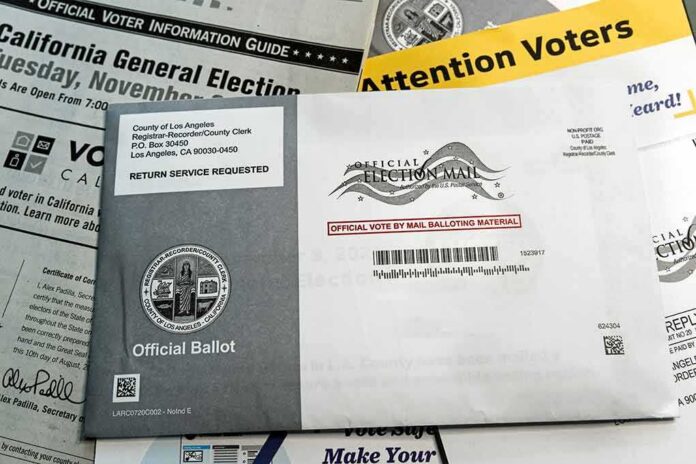
California voters already said yes once to a “temporary” tax hike on the rich, then said yes again to stretch it out. Now Sacramento wants them to make it permanent, forever.
Quick Take
- Proposition 3 would permanently lock in top income tax rates of 10.3%, 11.3%, and 12.3% that are set to expire after 2030
- The Legislative Analyst’s Office says the measure preserves between $5 billion and $15 billion a year in state revenue
- The tax hits individuals earning over $371,000 a year and funds schools and, indirectly, health care
- Opponents call it a broken promise, since the increase was pitched as a short-term fix back in 2012
A Tax Sold As Temporary Faces Its Third Act
California’s top earners have been paying elevated income tax rates since 2012, when voters passed Proposition 30 as an emergency response to a budget crisis. Voters extended it again in 2016 through Proposition 55, pushing the expiration date to 2030. Proposition 3 on this November’s ballot would erase that expiration date entirely, according to the nonpartisan Legislative Analyst’s Office and the Berkeley Institute of Governmental Studies guide.
The rates in question are not small. Individuals making more than $371,000 a year currently pay 10.3%, 11.3%, or 12.3% depending on income tier, on top of regular state brackets. If Proposition 3 fails, those rates snap back down to 9.3% starting in 2031, according to the official Legislative Analyst’s Office analysis.
What Proposition 3 Actually Does
The mechanics are straightforward. Proposition 3 does not raise anyone’s taxes. It simply removes the sunset clause on rates that already exist. The California Secretary of State’s official guide confirms the brackets stay the same, adjusted annually for inflation, and no taxpayer below $371,000 sees any change at all.
The fiscal stakes are large but fuzzy. State analysts peg the preserved revenue at $5 billion to $15 billion a year, a range wide enough to drive a truck through. That spread depends on stock market swings, capital gains, and how many high earners stick around, since the money comes almost entirely from a small, mobile slice of taxpayers.
Where the Money Goes
Supporters point to a clear funding trail. The Los Angeles Times reports that 89% of revenue from the existing tax goes to K-12 schools, with 11% going to community colleges, a split confirmed by Spectrum News using Legislative Analyst’s Office figures. CalMatters notes the measure also indirectly supports health care, by freeing up general-fund dollars that would otherwise cover education costs.
That health care connection is a budget-shuffle, not a dedicated account. There is no line item sending Proposition 3 dollars straight into hospitals or clinics. Supporters, including the California Teachers Association and unions representing health care workers, frame the arrangement as stabilizing both sectors by freeing up room elsewhere in the state budget.
The Opposition Case: Broken Promises and Flight Risk
The Howard Jarvis Taxpayers Association calls the whole premise dishonest. Susan Shelley, the group’s vice president of communications, says voters were told in 2012 this was temporary, and turning it permanent now breaks that word to taxpayers, while also squeezing small businesses that pay at individual rates.
The California Taxpayers Association argues the state should fix its spending habits before asking for more permanent revenue, framing waste and mismanagement as the real problem rather than insufficient tax collection. A CalMatters opinion piece adds that once government adjusts its budget to higher revenue, that revenue quietly becomes the new baseline, regardless of what voters were originally promised.
The Research Fight Over Who Really Pays
Economists disagree sharply on how high earners respond to these rates. Stanford researcher Joshua Rauh has found that departure rates among soon-to-be top-bracket taxpayers rose after the 2012 increase, and estimates tied to his work suggest California lost billions in forgone revenue to migration and reduced reported income over two decades.
Other researchers push back hard on that framing, arguing that tax-driven flight is mostly myth and that high earners rarely leave in numbers large enough to offset the extra revenue collected. The Legislative Analyst’s Office itself projected Proposition 55 would raise $4 billion to $9 billion a year, and those earlier estimates have historically held up, even as debate over long-term migration effects continues.
Ballot 2026:
While California Prop 40 is getting the headlines (Billionaires tax), Prop 3 has a far greater impact on high-earners like pro athletes.Here's what a defeat of Prop 3 would do to 2027 after-tax income for Matthew Stafford (if Prop 3 passes/left vs fails/right). https://t.co/Bha3x9B7lS pic.twitter.com/8Z1gfbeM1y
— JockTaxes (@JockTaxes) October 21, 2026
What Voters Are Really Deciding
This vote is not really about whether California can tax its wealthiest residents. That question was settled in 2012 and again in 2016. The real question is whether a policy built and sold as an emergency bridge should become a permanent fixture of the state’s tax code, written into the constitution where future legislatures cannot easily touch it.
Conservatives have a straightforward complaint here: a promise is a promise. Taxpayers were told this would end. Converting it into permanent policy through an amendment, rather than returning to voters again closer to 2030, asks Californians to trust that this time, unlike last time, “temporary” won’t quietly become forever.
Sources:
redstate.com, quickguidetoprops.sos.ca.gov, lao.ca.gov, latimes.com, igs.berkeley.edu, californiachoices.org, calmatters.org, hoover.org
© featuredheadlines.com 2026. All rights reserved.