

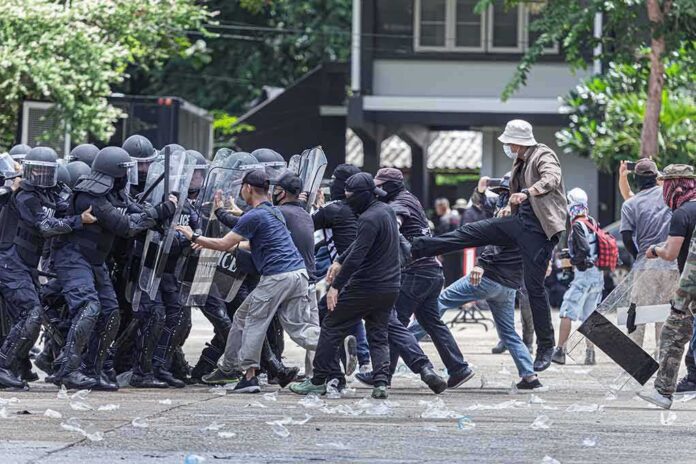
Several hundred demonstrators forced their way into Rome’s Colosseum as unrest flared across European cities.
Story Snapshot
- Students and young protesters briefly occupied the Colosseum in Rome
- Clashes with police near the monument included water cannons and tear gas
- Barcelona saw vandalism, fires, and dozens of arrests amid central-city disorder
- Events shared timing, but clear cross-border coordination is not established
Rome’s Ancient Icon Became A Protest Stage
The Associated Press reported that several hundred students and young demonstrators briefly occupied the Colosseum, waving Palestinian flags and denouncing the Gaza war and Italy’s leaders. The entry turned one of the world’s most visited landmarks into a protest platform. The symbolism was sharp: a two-thousand-year-old arena met a plugged-in generation testing state limits. The breach did not last long, but it seized global attention and reset the stakes for Italian authorities.
Reports from Rome described standoffs and scuffles with police near the Colosseum. Demonstrators threw bottles. Police responded with water cannons and tear gas to break up the crowd and keep routes clear. Street protests often split between lawful marches and small groups who push boundaries. Rome followed that script. The size of the larger protest gave cover and energy, while a more aggressive core sought confrontation and spectacle at a world-famous site.
Barcelona’s Night Of Broken Glass And Burning Bins
Central Barcelona faced a rougher edge. Masked youths near Plaça de Catalunya vandalized shops, looted businesses, burned rubbish containers, and hurled stones at officers, according to broadcast summaries. Disorder spread block by block as police tried to hold key intersections and protect storefronts. The same summaries linked the unrest to broader anger over costs and politics, but the scenes looked like fast-moving street crime riding the wake of a protest surge rather than an organized march with clear leaders.
Arrests followed. Reports cited an approximate total near one hundred detainees in Barcelona, including minors, after the worst clashes. Large urban police forces plan for this pattern. They let peaceful crowds move, then box in the violent fringe, and pick off offenders when momentum slows. That method limits injuries and property loss, but it frustrates residents who want quicker relief and shop owners who must board up before nightfall.
Is This One Wave, Or Many Ripples?
Coverage spanned several outlets and countries, creating the feel of a single European spiral. The timing matched, but the causes did not. Rome’s rhetoric centered on Gaza and Italy’s government. Barcelona’s reports leaned into local grievances and opportunistic vandalism. Shared anger is not the same as shared plans. Without named organizers or common logistics, the simplest read is parallel local fires lit by different sparks.
Large-scale protests are taking place in several Italian cities, including Turin, Rome, Bologna, Milan and Florence, as well as Barcelona in Spain, where clashes have erupted between police and demonstrators. Protesters threw bottles, stones and fireworks at police, while… pic.twitter.com/xFBB530O8M
— TAM (@Awakeningmedia1) October 25, 2026
The pattern still matters. Big protests usually stay peaceful, but a small share can tip into violence. Research on thousands of events shows that dynamic again and again. Crowds are magnets for agitators seeking a stage. Police adapt, sometimes with stronger crowd control, sometimes with targeted arrests. Conservative common sense lines up with the facts here: protect historic sites, protect the public, and draw a bright line between speech and smashing windows.
What Officials Must Do Next
Italian authorities have two jobs after the Colosseum breach. First, protect national heritage with tighter perimeters, quicker gate control, and clear arrest policies at restricted sites. Second, keep the capital open for lawful protest while denying any repeat of forced entries. Spain faces a similar two-track task in Barcelona: shield commerce and transit from roving vandalism, while channeling large demonstrations into safe routes that police can manage without citywide disruption.
How This Plays For Tourists, Locals, And Leaders
Tourists will see more fencing, more officers, and faster closures at iconic sites. Locals will demand faster cleanup and compensation where shops were hit. Leaders who show firm but fair control will calm markets and travelers. Leaders who wobble will see the next march test a new line. The message from Rome and Barcelona is simple: let people speak, but keep order sacred. When police move fast and courts back them up, the city breathes again by morning.
Sources:
ground.news, redstate.com, emakedonia.gr, b92.net, news.abplive.com
© featuredheadlines.com 2026. All rights reserved.