

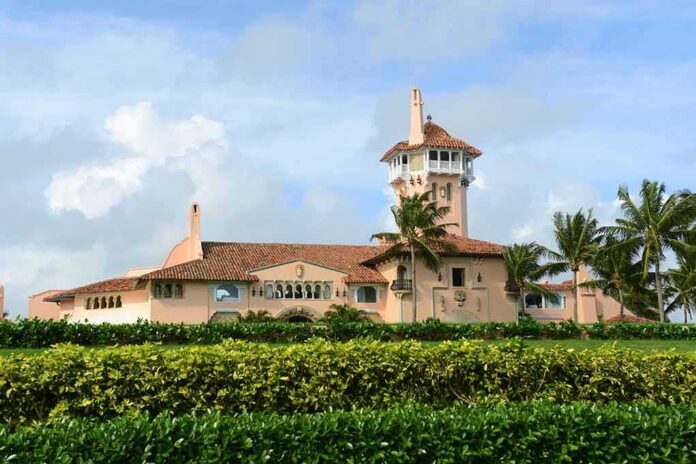
Soldiers quietly rolled ground-based air-defense systems onto the grounds of Mar-a-Lago, turning President Trump’s Florida retreat into one of the most heavily defended private properties in the country.
Quick Take
- Ground-based air-defense systems now sit in and around Mar-a-Lago at the Secret Service’s request.
- A 2019 government audit found four early Mar-a-Lago trips cost taxpayers about $13.6 million.
- Officials have not said how long the missile systems will stay or what exact threat triggered them.
- Past presidents also ran up multi-million dollar security bills traveling to personal homes.
Missiles Arrive at a Private Florida Resort
Ground-based air-defense equipment showed up at Mar-a-Lago after the Secret Service asked for it. Reporting tied the move to an intelligence memo warning officials about a possible Iran-linked plot, though that memo never actually names Mar-a-Lago as a target. Neither the Secret Service nor North American Aerospace Defense Command has said when the systems arrived or how long they plan to keep them there.
https://www.youtube.com/watch?v=uSAngAkkbyc
That silence leaves a gap between what the public knows and what security planners know. A missile system parked next to a resort full of guests, staff, and club members is not a small decision. Taxpayers deserve a general sense of the threat and the plan, even if full operational details stay classified for good reason.
What the Last Audit Actually Found
The clearest paper trail on Mar-a-Lago security comes from a 2019 Government Accountability Office report. Investigators estimated federal agencies spent about $13.6 million protecting President Trump during four trips to the resort between February 3 and March 5, 2017. Roughly $10.6 million went to aircraft and boat operations, with another $3 million covering housing, meals, and travel for support staff.
That price tag reflected a real, multi-agency effort. The Department of Defense covered about $8.5 million of the bill, while the Department of Homeland Security picked up roughly $5.1 million more. Reporters also noted the Secret Service booked nearby hotel rooms to build a security ring around the president, with officials describing it as “360-degree protection”. None of that figure, however, covers the newer missile deployment, which remains financially unaccounted for in public records.
Questions Officials Haven’t Answered Yet
Lawmakers have pushed back on Mar-a-Lago costs before. Senators and representatives flagged the $13.6 million figure in 2019 and noted that, among agencies required to report protection costs to Congress twice a year, only the Coast Guard had actually been doing it consistently. That’s not proof of waste, but it’s a real transparency gap Congress has a duty to close, regardless of which party occupies the White House.
Separately, Representative Ted Lieu pushed the SWAMP Act, a bill that would have required reimbursement for taxpayer costs tied to presidential visits at properties the president personally owns. Earlier watchdog estimates pegged the running cost of Mar-a-Lago weekends at roughly $3 million each, a number government auditors agreed was significant enough to warrant formal review.
A Pattern That Predates This Presidency
Presidential travel security has never been cheap, no matter who holds the office. A 2013 trip by President Obama to Chicago and Palm Beach cost the Department of Defense and Department of Homeland Security about $3.6 million combined, covering aircraft, Coast Guard boats, lodging, and meals. The categories look familiar because presidential protection always requires the same basic building blocks: air support, water security, housing, and manpower.
Critics of missile-defense spending broadly argue the country already pours staggering sums into similar systems, with one commentary estimating the nation’s missile-defense efforts have cost more than $531 billion over time. That’s a fair debate about national priorities. But protecting a sitting president is a different category of spending than a strategic weapons program, and conflating the two risks confusing the actual question at hand: was this specific deployment necessary, and what did it cost?
The Real Cost of Protecting a President
None of this means the missile systems at Mar-a-Lago are wasteful or unjustified. Presidents face real threats, and the Secret Service’s job is to act on intelligence before tragedy strikes, not after. But taxpayers and Congress have a legitimate right to know the basic scope, duration, and cost of a major new security posture at a private club, even a general outline of the answer builds confidence that the system is working as intended.
Sources:
gao.gov, hsgac.senate.gov, staugustine.com, palmbeachpost.com, thehill.com, beyondnuclearinternational.org, cronkitenews.azpbs.org, thefloridapress.com
© featuredheadlines.com 2026. All rights reserved.