

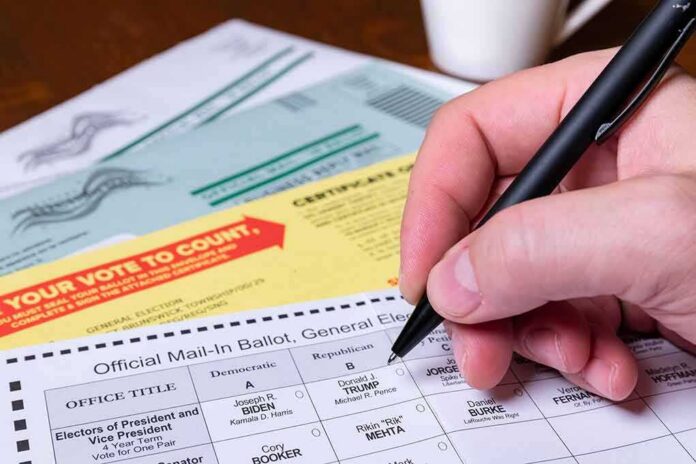
A man serving a 20-year federal sentence in New York pulled nearly 23,000 votes in Alaska’s House race—and the winner still had to scrape past 51 percent to finish the job.
Story Snapshot
- Republican Nick Begich won reelection 51.35% to 48.65% in Alaska’s ranked-choice count.
- Eric Hafner, a convicted felon in a New York prison, was the only listed Democrat and drew almost 8%.
- Reports say an unknown backer likely boosted Hafner to confuse voters and aid Begich, though proof of coordination is missing.
- Transfer data show many Hafner voters later ranked independent Bill Hill, muddying the “spoiler” claim.
How a prisoner became Alaska’s Democrat on the ballot
Alaska voters saw a Democrat on the ballot who was not in Alaska, had never visited, and was serving time in a New York federal prison. The New York Times reported Eric Hafner was incarcerated at Otisville while appearing as Alaska’s lone Democrat for the U.S. House seat. The Juneau Empire and Anchorage Daily News detailed how Hafner paid a small filing fee from prison to qualify, then advanced to November after several Republicans withdrew in the top-four system. None of that proves a scheme. It does establish a bizarre path to the ballot.
Hafner’s record carried more shock. He was convicted in 2022 of making threats to kill judges, police, and others, and is serving a 20-year sentence, according to coverage cited by national outlets. Alaska’s voter guide published his official statement and party registration as a Democrat, presenting a generic platform for change rather than a decoy pitch. The contrast between the candidate label and the prison cell created a simple, potent picture: someone far from Alaska, with a violent threat conviction, wearing the “D” on the ballot.
What the vote totals really show
Begich led the first round with about 47.6 percent, while independent Bill Hill sat near 41.8 percent, leaving Hafner close to 8 percent. The ranked count ended 51.35 percent to 48.65 percent for Begich, a narrow but clear win in Alaska’s system. The attention-grabbing number was Hafner’s haul: almost 23,000 first-choice votes. That is enough to matter in a tight race, which is why many on the left cried spoiler and demanded answers about who boosted him.
One hard datapoint cuts against a simple spoiler story. FairVote’s summary shows 45 percent of Hafner’s ballots transferred to Hill in later rounds, while about 6 percent transferred to Begich. A large remainder exhausted or went elsewhere. That pattern does not match the claim that Hafner voters mostly helped Begich in the ranked count. The first-choice optics hurt Democrats, but the transfer math softened the blow. This is the catch with ranked-choice voting: surface numbers can mislead if you skip the reallocation trail.
The allegation of a quiet hand—and the gap in proof
The New York Times reported that an unknown benefactor likely sought to confuse voters and aid Begich by keeping or promoting Hafner on the ballot. The Juneau Empire described unusual steps around his filing and the primary-to-general jump after withdrawals. Those facts raise fair questions. But no source has yet named the benefactor, shown a money trail, or produced messages tying any Republican decision-maker to Hafner’s effort. That matters for anyone who values clear lines, not hunches.
Congratulations to Rep. Nick Begich on his reelection! Alaska's open-primary, ranked-choice system put a federal prisoner who has never set foot in the state on the ballot, and he pulled 23,000 votes. Alaska deserves simple, clear elections. Time to end ranked-choice voting.
— ADDLEPATED DSF (@DSFisAddlepated) November 22, 2026
Hafner’s mother, Carol, publicly denied any Republican contact and said no one encouraged her son to run. Newsweek and other outlets published her on-the-record claims of zero contact, and described a distinction between defending his ballot status and recruiting him. Voters can judge the strength of that denial, but it does mark the only direct, named rebuttal on coordination from inside Hafner’s circle at this stage.
What conservatives should take from Alaska’s close call
The result affirms a basic truth: show up, stand your ground, and win on ideas even when the ballot gets weird. Begich did not need a landslide; he needed a majority under the rules, and he earned it. The broader lesson is calmer and tougher. Ranked-choice voting rewards clear brands, disciplined turnout, and smart second-choice appeal. It punishes confusion less than some claim, but it does invite stunts that can warp first impressions. The fix is sunlight—disclosure, not drama.
Sources:
thegatewaypundit.com, nytimes.com, npr.org, juneauempire.com, latimes.com, thehill.com, elections.alaska.gov, kyuk.org
© featuredheadlines.com 2026. All rights reserved.