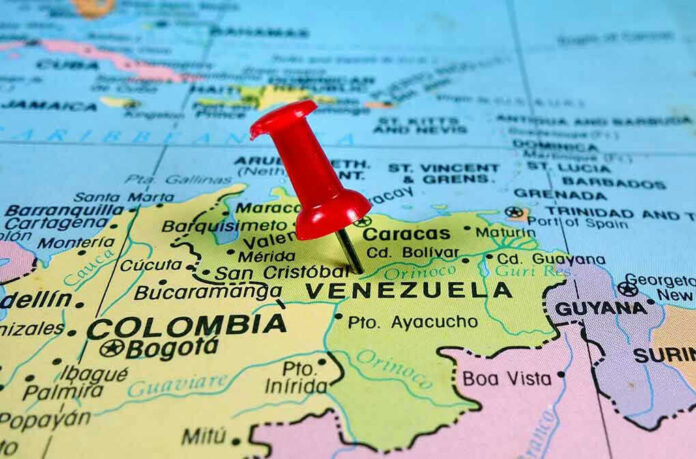
Could a mysterious “sonic weapon” have really been used by the United States to incapacitate Venezuelan soldiers during the dramatic raid to capture President Nicolás Maduro?
Story Highlights
- An eyewitness claims US forces used a “sonic weapon” causing severe physiological effects.
- The operation, dubbed Operation Absolute Resolve, led to the capture of Maduro.
- Approximately 100 Venezuelan soldiers reportedly died with no US casualties.
- The story’s credibility is questioned due to a lack of official confirmation and reliance on a single anonymous source.
The Eyewitness Account and Its Implications
A Venezuelan security guard’s account has gripped the world, claiming that during a US military raid on the Fuerte Tiuna military complex in Caracas, a “sonic weapon” was deployed. The guard described soldiers experiencing the sensation of their heads exploding from within, coupled with severe nosebleeds and vomiting blood. These dramatic descriptions, if true, suggest the use of advanced military technology capable of incapacitating without conventional weaponry.
Despite the sensational nature of this claim, the story is based on an anonymous source and lacks physical evidence or official confirmation from US authorities. The US military’s silence on these claims has only fueled speculation and intrigue, leaving the public to wonder about the capabilities of modern warfare technology.
The Raid and Its Context
The raid occurred in early January 2026 at the Fuerte Tiuna military base, a significant stronghold in Venezuela. The operation, involving drones, helicopters, and alleged directed-energy weapons, was aimed at capturing the embattled Venezuelan President Nicolás Maduro. This move represented a significant escalation in US-Venezuela relations, marked by years of tension, economic sanctions, and US support for opposition forces within Venezuela.
Operation Absolute Resolve took place under the Trump administration’s directive to neutralize perceived threats in Latin America. The operation highlights the strategic importance of Venezuela in US foreign policy, particularly regarding its alliances with Russia and Iran. The raid’s implications extend beyond the immediate military success, potentially signaling a new era of technological warfare.
The Technology Behind the Claims
The idea of a “sonic weapon” is not unprecedented. The US military has been exploring directed-energy weapons, including microwave and laser systems, for decades. Such technologies are rumored to cause pain, disorientation, and even physical harm. However, there is no concrete evidence linking these technologies to the Venezuelan raid. The symptoms described align with directed-energy effects, but the lack of corroborative evidence makes it difficult to validate the eyewitness account.
Analysts suggest that the operation likely involved advanced drones and precision strikes, which are well-documented capabilities of the US military. The absence of visual or audio evidence of a sonic weapon further complicates the narrative, leading some experts to dismiss the claims as speculative.
Political and Military Ramifications
The raid’s political fallout is significant. The Venezuelan government reported approximately 100 military casualties, a stark contrast to the US’s claim of no casualties. This discrepancy raises questions about the operation’s transparency and legality, stirring political debates within the United States and internationally. The story has been amplified by figures such as White House Press Secretary Karoline Leavitt, who shared the viral account on social media, further intensifying public interest and scrutiny.
From a military perspective, the raid underscores the US’s technological edge and its willingness to deploy advanced tactics in high-stakes scenarios. It serves as a deterrent message to other nations considering alliances with US adversaries. However, the operation also exposes vulnerabilities in Venezuela’s Russian-backed defense systems, potentially prompting a reevaluation of military strategies and alliances in the region.