
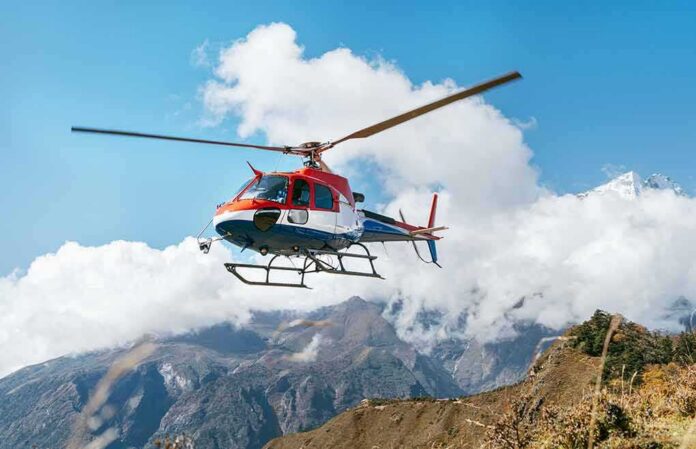
Two commercial helicopters tried to land on the same high-altitude helipad near Everest and their rotors met first.
Story Snapshot
- Collision happened around 8:11–8:12 a.m. at the Pheriche helipad in Solukhumbu
- Operators identified as Fishtail Air and Air Dynasty by police and aviation officials
- One passenger, a 47-year-old Indian national, died at the scene; several others were hurt
- Officials say the blades struck during landing attempts on the same pad
Two Helicopters, One Helipad, A Deadly Minute
Nepal Police and the Civil Aviation Authority of Nepal reported that two helicopters collided while attempting to land at the Pheriche helipad in Khumbu Pasanglhamu-4 at about 8:11 to 8:12 a.m. on November 3, 2026. Officials identified the aircraft as operated by Fishtail Air and Air Dynasty. The crash site sits on the Everest trekking corridor where flight activity is intense after dawn. The collision left one passenger dead and injured others, according to the initial counts.
Police named the deceased as 47-year-old Indian national Vasant Kumar Balramudu of Chennai, Tamil Nadu. Reports said three people were injured: passenger Selishkumar Patel and pilots Ravindra Prajapati and Prajal K.C.. Earlier figures varied as responders moved patients from Pheriche to Lukla and onward to hospitals. Early variations in injury counts are common in remote mountain zones where evacuation happens in stages and multiple agencies report in parallel.
What Officials Say About How It Happened
The Civil Aviation Authority of Nepal information office said the helicopters’ rotor systems struck during landing. A district police inspector said both pilots appeared to aim for the same helipad at once, and one helicopter’s blades hit the other. That description fits the short, packed approach profile at Pheriche. Helicopters approach over uneven ground with thin air, brisk winds, and limited lateral clearance. A small timing error can erase the separation that keeps blades safe.
Accounts placed one aircraft inbound from another location while the other was already in the landing flow, but all aligned on rotor contact as the key trigger. That mechanism also explains how injuries can occur without a full post-impact fire. Rotor strikes convert huge spinning energy into flying debris and sudden loss of control. On a tight pad, there is little room to recover. Crews often keep fuel low to meet weight limits at altitude, which can reduce but not remove fire risk after impact.
Why This Pad, Why This Morning
Pheriche is a favored staging point below Everest Base Camp, where rescue, cargo, and trekking support flights overlap after sunrise. Operators often compress schedules to beat midday winds. At 14,000 feet class terrain, power margins shrink and aircraft need more rotor pitch to hover, which narrows safety buffers. If two machines commit to the same final at once, even a prompt radio call may come too late. Authorities noted the site sits outside the full control of Lukla’s tower, making pilot-to-pilot coordination vital.
A helicopter collision near Mount Everest has killed an Indian national and injured another passenger. Days earlier, a hotel fire along the Everest Base Camp route raised fresh safety concerns.
Know more on #VantageOnFirstpost with @SaroyaHem at 9 PM IST:… pic.twitter.com/KBfpdlyRsh
— Firstpost (@firstpost) November 3, 2026
None of these realities excuse poor deconfliction. They explain why strict procedures and clear, simple comms matter most at altitude. Conservative discipline—one pad, one aircraft, one clear go-around—saves lives. That is common sense and basic airmanship. When tourism pressure meets thin air, leaders must back pilots who wave off and wait. Busy mornings are not a reason to bend rules; they are the reason not to.
Names, Operators, And The Record In Nepal
Police and aviation officials named the operators as Fishtail Air and Air Dynasty and placed the crash on November 3 at Pheriche, Solukhumbu. Media aligned on the casualty identity and operator pairings through the day, with India’s public broadcaster detailing the victim’s name and the injured list. Aviation outlets echoed the same core facts and time window, focusing on rotor contact during landing and the high-altitude pad environment. The consistency across these points supports the timeline and the who, what, and where.
Nepal’s helicopter sector has long carried elevated risk because of terrain, weather, and remote pads. Government and industry records show repeated fatal helicopter events in mountain regions over decades. Safety reports have urged better standard operating procedures, rigorous crew training, and improved pad management. These measures do not blame specific crews in this case. They offer a plain lesson: in thin air, the margin of error is smaller, so the margin of planning must be larger.
What To Watch Next
Authorities will finalize the injury roster, confirm aircraft identities, and publish findings on sequence and responsibility. The crucial questions are simple: who had the pad, what calls were made, and why did two machines commit to the same spot? Operators and regulators should move fast on interim steps that do not need a full report—reinforce radio phraseology at uncontrolled helipads, require visible pad guards for sequencing, and mandate staggered company dispatch during peak surges. That is how you honor the victim and protect the next passenger.
Sources:
ianslive.in, thehimalayantimes.com, ddnews.gov.in, uk.news.yahoo.com, thelogicalindian.com, english.onlinekhabar.com
© featuredheadlines.com 2026. All rights reserved.