

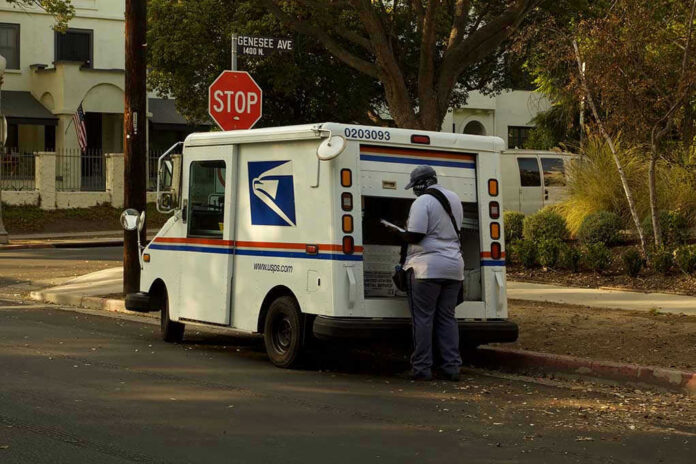
A massive breach of public trust has rocked the nation as a government employee exploited her federal position to steal from hardworking Americans, exposing systemic vulnerabilities that demand urgent accountability.
Story Snapshot
- A California USPS worker stole over 130 cards and 16 Treasury checks, funding luxury purchases and tropical vacations.
- Despite a law enforcement search and ongoing investigation, the thefts and fraud continued for months.
- Flaunting her ill-gotten wealth on social media, the perpetrator showcased the audacity of insider crime in federal institutions.
- She pleaded guilty in August 2025 and faces up to 30 years in federal prison, highlighting critical gaps in USPS oversight.
Rampant Insider Theft Exposes Deep Flaws in USPS Security
Mary Ann Magdamit, a former postal worker in Torrance, California, orchestrated one of the most egregious internal thefts in recent USPS history. Between 2022 and July 2025, she systematically stole over 130 credit and debit cards and 16 U.S. Treasury checks directly from the mail she handled. Her actions spotlight the persistent risk of insider crime within federal institutions and raise pressing questions about the adequacy of government safeguards meant to protect citizens’ private information and financial security.
Law enforcement first searched Magdamit’s apartment in December 2024, uncovering 133 stolen cards, 16 Treasury checks, and a loaded ghost gun. Despite this investigation and the clear evidence of wrongdoing, she continued her fraudulent activities for several months, exploiting lapses in internal monitoring. This ongoing criminal conduct, even under scrutiny, starkly illustrates the weakness of government oversight and the dangers of misplaced trust in federal employees. It is precisely the kind of government failure that fuels public frustration with bureaucratic complacency and lack of accountability.
Government Oversight Failures and the Culture of Flaunted Criminality
Throughout her scheme, Magdamit used stolen financial instruments to purchase luxury goods, including a Rolex watch, and fund lavish vacations to destinations such as Turks and Caicos and Aruba. She brazenly flaunted this illicit lifestyle on Instagram, posting images of high-end goods and stacks of cash. Such public displays not only reveal the psychology of entitlement among some government workers but also highlight how criminal behavior can go unchecked within poorly monitored agencies. This case exemplifies the consequences of a culture where government employees believe they are above the law—a scenario that conservative Americans have long warned against.
Magdamit did not act alone; co-conspirators assisted in cashing stolen checks using fake identification documents, further complicating the web of fraud and demonstrating the broader risks posed by insufficient background checks and internal controls. The victims, ordinary mail recipients in the greater Los Angeles region, suffered financial loss, identity theft, and severe disruption—collateral damage of a system that failed to protect them. The USPS, as both employer and steward of public trust, now faces increased scrutiny and pressure to reform its hiring and oversight practices to restore confidence in its integrity.
Legal Consequences and Calls for Institutional Reform
After her arrest on July 1, 2025, and subsequent guilty plea on August 11, Magdamit now faces up to 30 years in federal prison, with sentencing scheduled for late October. As part of her plea agreement, she will forfeit luxury items purchased with stolen funds. Federal prosecutors and postal inspectors have emphasized the seriousness of the breach, but the fact that such extensive theft could persist for years underlines the need for more robust internal controls, staff vetting, and real consequences for criminals operating within the federal workforce. Many conservatives view this as a clear example of why unchecked government power and lack of transparency imperil constitutional rights and public safety.
US postal worker stole cards and checks from mail to fund lavish lifestyle, tropical vacations she flaunted online https://t.co/IDxVL8IuaG
— Financial Crime News Briefs (@FinCrime_News) August 13, 2025
Public reaction to the case has been fierce, especially among those already wary of government overreach and bureaucratic inefficiency. The incident has renewed calls for USPS reform, including enhanced employee screening, stricter monitoring, and swift action against any insider threats. For many, this case is a stark reminder that the principles of individual responsibility and limited government must guide the stewardship of taxpayer-funded institutions. With increasing political pressure, lawmakers and agency officials are being urged to implement lasting changes to prevent future abuses and restore the public’s faith in critical federal services.
Expert Perspectives: Systemic Risks and the Path Forward
Postal security experts and financial fraud analysts agree that the sophistication of Magdamit’s scheme underscores the growing challenge of insider threats in large public institutions. The widespread use of social media to flaunt criminal proceeds complicates detection but also provides investigators with new tools to track illicit activity. Criminologists point to the psychological motivations behind the public display of ill-gotten gains, emphasizing the need for both deterrence and cultural change within government agencies. Legal scholars stress that aggressive federal prosecution is essential to set a precedent and deter similar crimes, while some commentators advocate for systemic reforms within the USPS to address root causes rather than just individual wrongdoing.
Sources:
South Bay USPS Worker Used Stolen Credit Cards To Buy Rolex, International Vacations (Patch)
USPS carrier stole cards to fund luxury purchases (LA Times)
USPS employee flaunted cash on Instagram, used stolen checks for trips, pleads guilty (Fox LA)