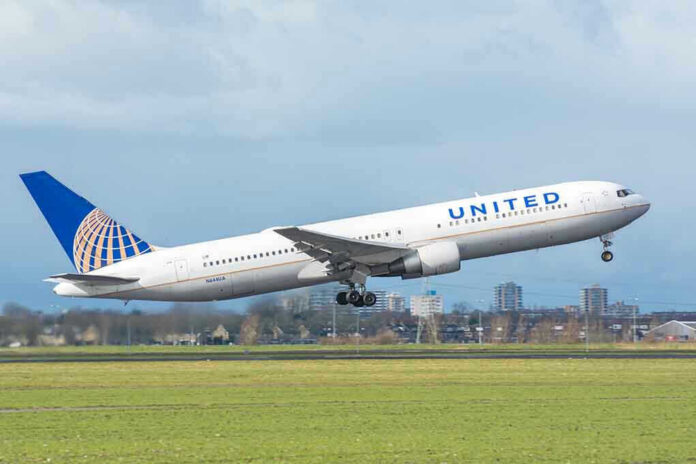
A United Airlines Boeing 737 reportedly collided with an unidentified flying object at 3,000 feet over San Diego, an altitude where drones are strictly prohibited and encounters with commercial aircraft should be virtually impossible.
Story Snapshot
- United Airlines Flight 1980 from San Francisco struck a small, red, shiny object at approximately 3,000 feet near San Diego International Airport on a Wednesday afternoon
- The pilot described the object as possibly a drone but admitted uncertainty due to its small size, reporting no injuries or visible damage to the aircraft
- The incident remains unconfirmed by FAA, ATC, or United Airlines, with evidence limited to viral ATC audio circulating on social media and aviation apps
- The collision occurred at nearly eight times the legal altitude limit for recreational drones, raising questions about illegal high-altitude operations or potential misidentification
When Common Sense Airspace Rules Meet Uncommon Reality
Federal Aviation Administration regulations draw a hard line at 400 feet for recreational drone operations without special waivers. At 3,000 feet, Flight 1980 cruised in Class B airspace where drone activity is not just discouraged but explicitly banned near airports. Yet the pilot’s post-landing report to ground control suggested something violated that protected zone. The Boeing 737 descended toward runway 27 without incident, but the encounter raises uncomfortable questions about enforcement gaps in America’s increasingly crowded skies.
The Mystery Object Nobody Can Confirm
The pilot’s recorded transmission provides the only direct evidence of the encounter. His description vacillated between certainty and doubt: a drone, red and shiny, yet so small he couldn’t definitively identify it. No official confirmation has emerged from United Airlines, the FAA, or air traffic control authorities. The absence of official statements creates an information vacuum filled by viral social media posts and aviation enthusiast apps sharing the unverified audio. This pattern exemplifies modern incident reporting where public awareness races ahead of institutional verification.
United Airlines flight reportedly hits drone at 3,000 feet over San Diegohttps://t.co/6UHJ8JSaU3
— Bodoxstocks (@bodoxstocks) April 29, 2026
What Three Thousand Feet Actually Means
Commercial aircraft routinely operate at this altitude during approach and departure phases, making any foreign object encounter potentially catastrophic. Birds occasionally reach these heights during migration, and weather balloons drift through commercial corridors, but drones achieving this altitude require deliberate effort and sophisticated equipment far beyond typical consumer models. The collision site over San Diego placed the incident in one of California’s busiest aviation corridors, where San Diego International Airport manages constant traffic through strictly controlled airspace with multiple protective layers designed to prevent exactly this scenario.
The Growing Drone Threat Pattern
Global incident trackers document hundreds of drone encounters with aircraft since 2021, revealing a troubling upward trajectory. The technology barrier continues dropping as consumer drones gain range, altitude capability, and battery life. Some operators ignore restrictions through ignorance, while others deliberately violate them. The Gatwick Airport shutdown in 2018 demonstrated how even unconfirmed drone sightings can paralyze major aviation hubs. American airports face similar vulnerabilities, compounded by enforcement challenges across vast airspace and limited resources to prosecute violators when identified.
The Identification Problem Aviation Faces
Pilots glimpse unexpected objects for split seconds while managing complex approach procedures. At 3,000 feet, relative closing speeds make visual identification nearly impossible before an object passes. The Flight 1980 pilot’s honesty about uncertainty deserves recognition rather than criticism. Aviation professionals understand that red, shiny, and small describes multiple possibilities: mylar balloons, experimental aircraft, large birds with distinctive plumage, or indeed an illegally operated drone. The rush to label incidents definitively before investigation serves neither safety nor truth.
What Accountability Looks Like In American Skies
Conservative principles demand both personal responsibility and proportionate regulation. Drone operators who endanger passenger aircraft through reckless altitude violations deserve serious consequences, but knee-jerk regulatory expansion punishes responsible hobbyists for others’ misconduct. The FAA’s remote identification mandates represent reasonable middle ground, enabling enforcement without crushing recreational use. This incident, if confirmed, demonstrates why such measures matter. However, the unconfirmed status also illustrates the danger of policy driven by viral social media rather than verified facts and measured analysis.
The Flight 1980 incident remains officially unresolved, suspended between pilot testimony and institutional silence. Whether the object was truly a drone, why it operated at illegal altitude, and who controlled it may never achieve definitive answers. What remains certain is that American airspace grows more complex yearly, with technology outpacing both regulation and enforcement. Common sense suggests that until authorities confirm otherwise, treating unverified reports with appropriate skepticism serves truth better than speculation, even when viral audio makes compelling listening.
Sources:
United Airlines flight 1980 reportedly hit by drone above San Diego
D-Fend Solutions Drone Incident Tracker