
The building beside a deep Brooklyn excavation crumpled in seconds, and the race for survivors began before the dust settled.
Story Snapshot
- The collapse struck near Flatbush and Bedford Avenues shortly after 4 p.m. as crews launched a massive rescue.
- Roughly 250 responders flooded the scene, including search dogs, drones, and bucket brigades.
- Rescuers pulled people from the rubble within hours, as cameras captured at least one live rescue.
- Officials said the search would continue into the night, with the toll rising as crews dug deeper.
What Happened And How The Rescue Unfolded
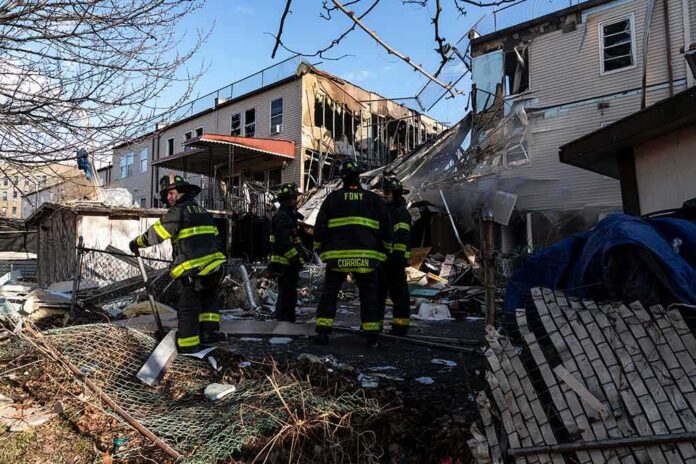
Witnesses watched a multistory structure fold toward an adjacent work pit near Flatbush and Bedford Avenues in Brooklyn, just after 4 p.m. Firefighters and emergency medical crews swarmed the block within minutes. Reporters on scene described rescuers crawling the debris, calling out for voices, and probing voids. Two people were removed soon after the collapse. Cameras later recorded a survivor pulled from the pile around 6:15 p.m., proof that speed and stubborn work still save lives.
Fire department leaders warned that more people might be trapped. The count of injured and dead rose as teams pushed in. Updates varied through the evening, from early tallies of one or two dead to later counts of multiple fatalities and more than a dozen injured. Officials urged patience while the methodical search continued across a dangerous and shifting site. Crews worked zones, flagged hazards, and held silence checks to listen for anyone still alive.
The Search Tools When Every Minute Matters
Rescuers attacked the rubble with simple tools that work when heavy gear risks new collapse. Bucket lines moved concrete by hand. Teams used cameras, listening devices, and drones to scan holes and pockets. Search dogs worked the fringes and then the interior. Vacuum trucks cleared dust and fine debris where a shovel could not. These are hard, low-tech methods built for speed and care, and they match what engineers recommend when walls are cracked and floors sit on air.
Commanders split the site into grids to manage risk. Workers cut rebar, cribbed unstable slabs, and built ramps for stretchers. Medics staged close to the hot zone with blood, airway kits, and thermal blankets. Police managed crowds and secured a perimeter. Fire marshals and building inspectors documented conditions as they found them. Each move had a purpose: protect rescuers, find survivors fast, and preserve evidence for the cause analysis to come.
Addresses, Identities, And The Tough Math Of Breaking News
Reporters described the collapse zone at or near 1321 Flatbush Avenue, with an adjacent dig tied to a Bedford Avenue lot. One outlet listed the collapsed address as 1321 Bedford Avenue. Such mix-ups are common at complex intersections, but they matter for records and responsibility. Officials also cautioned that some rescued people were not yet identified on scene. Families watched, waited, and hoped while responders continued to work.
Search underway a day after deadly Brooklyn building collapse https://t.co/fd34SWAWwM
— Reuters (@Reuters) November 12, 2026
Fatality and injury numbers changed across the first hours. Early reports ranged from one death and a dozen injuries to several deaths and more than 17 hurt. Later updates pointed to at least eight people dead and 17 injured as the search widened and night operations advanced. That shift reflects a simple truth of disaster math: counts harden only after the last void is searched and hospitals reconcile their logs.
Why The Building Failed And What Comes Next
City records and on-scene reports focused attention on the excavation next to a 96-year-old building at 1321 Flatbush Avenue. Plans for a large mixed-use project were linked to the pit. Investigators will test whether the dig changed soil support or load paths and how that interacted with an older masonry wall. They will also check permits, inspections, and any stop-work history. Final blame rests on evidence, not hunches, and that work has already begun.
New York City construction data shows that excavation and material failures sit among recurring incident types, with dozens of such events logged in recent annual tallies. Brooklyn’s pace of building keeps pressure on safety discipline, from shoring plans to wall bracing to neighbor protections. The lesson repeats after every collapse: follow the engineered sequence, respect the soil, and treat every old party wall like a loaded spring until it is braced and proven stable.
Accountability, Compassion, And A Clear Standard
Public safety demands straight answers and firm accountability. If contractors cut corners or ignored engineering, the city should act fast with fines, suspensions, or criminal charges where the law allows. If inspections missed warning signs, the department should fix the gaps and own the failure. Families deserve names, facts, and timelines, not spin. Conservative common sense says you set clear rules, enforce them evenly, and you do it before the sirens, not after.
For now, the priority stays on rescue. Crews will keep digging until the last viable space is cleared. Hospitals will update conditions. The medical examiner will confirm the victims. Investigators will release a cause timeline when the site is safe to map and measure. The city builds every day. It must build like lives depend on each trench, brace, and underpin. Because as Brooklyn saw, they do.
Sources:
youtube.com, abcnews.com, cbsnews.com, nytimes.com, nbcboston.com, nbcnewyork.com, abc7ny.com, nyc.gov, abc7news.com
© featuredheadlines.com 2026. All rights reserved.