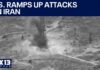
Iran launched ballistic missiles and attack drones at U.S. allies and a critical global shipping lane, and American forces knocked them out of the sky — then hit back.
Story Snapshot
- U.S. Central Command intercepted Iranian ballistic missiles and one-way attack drones targeting Kuwait, Bahrain, and the Strait of Hormuz.
- Gulf states intercepted hundreds of Iranian projectiles within a 24-hour period and issued a joint condemnation of Iran’s actions.
- U.S. forces struck Iranian radar sites and island positions in a retaliatory response operation.
- Iran claimed it targeted an American warship in the Sea of Oman — a claim the U.S. flatly and publicly rejected.
What U.S. Central Command Says Happened Over the Gulf
U.S. Central Command reported that American forces shot down Iranian ballistic missiles and one-way attack drones launched toward the Strait of Hormuz and Gulf Arab allies, specifically Kuwait and Bahrain. Initial assessments confirmed six Iranian missiles were intercepted, a seventh failed to reach its intended target, and four Iranian attack drones aimed at the global chokepoint were destroyed. No American casualties were reported in the engagements. [4]
The Strait of Hormuz is not a minor detail in this story. Roughly 20 percent of the world’s oil supply transits that narrow passage. Targeting it with attack drones is not a warning shot — it is a direct threat to the global economy, and every American who fills a gas tank has a stake in whether those drones get through. They did not. [14]
Gulf Allies Took Hits Too — and Responded With Condemnation
Kuwait and Bahrain both activated their own air defense systems as Iranian projectiles rained down across the region. Bahrain’s military reported downing three Iranian missiles along with a wave of drones. Gulf states collectively intercepted hundreds of Iranian missiles and drones within a single 24-hour window and issued a joint condemnation, signaling that regional partners are not passive observers in this conflict — they are active defenders. [3]
Kuwait International Airport became a flashpoint in the information war surrounding the strikes. Iran claimed a U.S. interceptor, not an Iranian drone, struck the civilian airport. U.S. Central Command responded directly and without diplomatic softening, calling the claim “Totally FALSE” and stating that Iran struck the civilian airport with drones in what it described as a deliberate, calculated, and unjustified attack. When a government has to defend itself against accusations of bombing an airport it was actively trying to protect, you understand how aggressively Iran is managing its own narrative. [6]
Iran’s Counterclaims Collapse Under Scrutiny
Iran also claimed it successfully targeted an American military vessel in the Sea of Oman. The United States denied this entirely. [1] This pattern — Iran announcing a strike, the U.S. disputing or disproving it — has become a predictable feature of these exchanges. Iran’s leadership faces enormous domestic pressure to project strength, and inflated battlefield claims serve that political purpose even when the facts do not cooperate. The problem is that false claims in a live conflict escalate misunderstanding into miscalculation.
U. S. forces intercepting those Iranian missiles and drones then striking Qeshm Island shows the resolve needed to protect the West from invaders.
— Silas Vorn (@ShphrdsVllyHmsd) June 3, 2026
Iran also reportedly used a Chinese-made missile in at least one engagement during this escalation cycle, raising questions about the weapons pipeline feeding Tehran’s arsenal. [8] That is a detail worth watching. If Chinese-origin hardware is showing up in Iranian strikes on U.S. allies and global shipping lanes, the diplomatic consequences extend well beyond the Gulf.
The U.S. Response Was Measured, Targeted, and Strategically Clear
American forces did not stop at interception. U.S. strikes hit Iranian radar installations and island positions in what military reporting described as a response operation. Targeting radar is precise and deliberate — it degrades Iran’s ability to coordinate future attacks without triggering the kind of mass-casualty response that pulls the entire region into open war. More than 90 percent of Iranian missiles and drones launched during this escalation period were intercepted by U.S., allied, and partner forces. [15] That number represents an extraordinary operational success, though analysts note the sheer volume of launches is itself a warning about sustainability.
What This Escalation Reveals About Iran’s Strategy
Iran is not trying to win a conventional war against the United States. It cannot. What it is doing is testing the limits of deterrence, probing for gaps in allied air defenses, generating propaganda victories for domestic consumption, and keeping pressure on Gulf states that host American forces. Launching hundreds of missiles and drones in 24 hours, even knowing most will be intercepted, imposes costs — on ammunition stockpiles, on operational tempo, on the political bandwidth of every government scrambling to respond. [13] The volume is the strategy. Understanding that changes how you think about what a ceasefire in this theater actually means.
Sources:
[1] Web – U.S. forces shot down Iranian missiles and drones aimed toward Gulf …
[3] YouTube – ON CAM: Iranian Ballistic Fury Hits ‘AMERICAN BASES’
[4] Web – Gulf states intercept hundreds of Iranian missiles and drones, issue …
[6] YouTube – Iranian drone attacks on Kuwait and Bahrain after US attacks on Iran
[8] Web – Iran war live: US forces down Iranian missiles targeting Kuwait and …
[13] Web – Iran Air Flight 655 – Wikipedia
[14] Web – US Forces Intercept Iranian Missiles and Drones as Tensions Persist …
[15] Web – U.S. forces intercept Iranian missiles, drones in self-defense
© featuredheadlines.com 2026. All rights reserved.