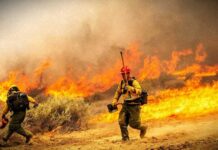

The battle over a narrow strip of water has turned into a nightly test of American power and Iranian nerve.
Story Snapshot
- United States forces are hitting Iran for the tenth straight night to reopen the Strait of Hormuz.
- Iran’s forces answer with missiles and drones, claiming they are defending their own waters.
- Global oil prices jump and civilian ships burn while Washington insists this is “self-defense.”
- Both sides tell very different stories about who started it and who is really protecting trade.
The chokepoint that can squeeze the world
The Strait of Hormuz is a tight sea passage that carries a huge share of the world’s oil, and that alone makes it dangerous. Iran sits on one side, U.S. and its partners guard the other, and every tanker that crosses becomes a pawn in a larger contest. Since early 2026, attacks on ships, missile launches, and seizures of vessels have turned this waterway into a war zone rather than a trade route. That pattern sets the stage for today’s ten nights of American strikes.
🚨 US Hits Iran for 10th Straight Night: Regime Attacks Tankers While Houthis Blockade Saudi Arabia
10th consecutive night of U.S. strikes degrading Iran’s ability to threaten the Strait of Hormuz—right after they attacked another tanker and their Houthi proxies moved to… https://t.co/Vd4Pc9pNro
— The Ugly Patriot (@the_uglypatriot) July 21, 2026
The current clash follows a familiar pattern in this area: Iran uses drones, small attack boats, and mines to harass shipping, while the United States answers with precision airstrikes meant to cripple those tools without sending troops to invade. Analysts call this asymmetric naval warfare, and it favors a regime like Iran that can hide its assets among civilian ports and busy sea lanes. That is why each “limited” strike risks killing civilians and wrecking commercial ships along the way.
What the United States says it is doing and why
U.S. Central Command, which oversees American forces in the region, says its goal is simple: stop Iran from attacking civilian ships and reopen the Strait for global trade. Over the last week, it has struck more than eighty Iranian targets, including air defense systems, command centers, coastal radar sites, anti-ship missile launchers, and over sixty small Islamic Revolutionary Guard Corps boats near the strait. The military frames these strikes as self-defense and a direct response to Iranian drones and missiles fired at tankers and cargo ships.
Recent American statements point to specific triggers. One was a drone attack against a commercial vessel that forced the crew to abandon ship in the narrow waterway. Another was an attack on the Cyprus-flagged container ship GFS Galaxy that left one crew member missing and the ship crippled by fire. U.S. officials say the Commander in Chief ordered the latest waves of strikes to hold Iranian forces accountable and to impose “heavy costs” for hitting civilian mariners.
How Iran answers and what it claims
Iran’s leaders tell a very different story. The Islamic Revolutionary Guard Corps argues that the Strait of Hormuz is under Iranian control and that Tehran has the right to manage navigation there. Iranian officials have accused the United States of breaking a recent ceasefire and violating a memorandum of understanding by revoking an oil sanctions waiver, claiming Washington’s blockade of Iranian ports forced them to react. To many in Iran’s media, the U.S. is not protecting trade; it is strangling Iran’s economy and hiding behind talk of “self-defense.”
Iran also disputes some of the basic facts. Revolutionary Guard statements carried by state outlets have denied that commercial ships crossed the Strait during key hours when U.S. commanders said tankers were transiting safely under American protection. At other times, Iranian sources suggested that damaged tankers struck mines instead of being hit by missiles, or that ships were warned to follow new routes but ignored instructions. None of those claims come with hard forensic evidence, which makes judging them a matter of narrative and trust rather than proof.
The toll on ships, civilians, and the global economy
While Washington and Tehran trade statements, crews on the water pay the price. The U.K. Maritime Trade Operations center recorded twenty-three attacks on vessels in the area in just two months, with several sailors killed or badly hurt. Recent strikes and counterstrikes left tankers aflame, crews abandoning ship, and one missing mariner from the GFS Galaxy. Iranian reports claim more than fifty people killed and hundreds wounded from U.S. attacks, though those figures remain hard to independently confirm.
US strikes Iran for 10th consecutive night as Tehran strikes tanker in the Strait of Hormuzhttps://t.co/39vDRTpLNE
— 7News Boston WHDH (@7News) July 21, 2026
Every time a tanker is hit or a strait is threatened, oil markets jump. Brent crude has already pushed toward ninety dollars a barrel during this crisis, echoing a previous spike past one hundred when both sides seized ships and blocked routes. Airlines have suspended flights to key Gulf hubs, and shippers weigh longer, costlier detours against the risk of running the gauntlet. For ordinary Americans, that shows up later as higher gas prices, costlier goods, and fresh pressure on politicians who now must defend far-off strikes to voters at home.
Power, principle, and the conservative lens
From a common-sense, right-of-center view, one core principle stands out: free trade routes matter, and regimes that fire on civilian ships break basic rules of order. If Iran used drones and missiles to hit tankers in international waters, as U.S. and several Gulf allies allege, then destroying the tools used for those attacks fits a clear self-defense logic. A government that cannot keep global sea lanes open looks weak to both friends and foes, and that weakness can invite more aggression.
Still, conservatives also care about limited government, clear objectives, and honest accounting. Ten straight nights of strikes without a clean endgame, rising civilian casualty claims, and no public forensic proof tying every attack to Iran raise serious questions about mission creep. Iran’s leaders exploit those doubts, pushing the idea that Washington broke its own ceasefire and then cried foul when Tehran pushed back. In the end, the truth may rest not just on statements, but on hard data that both sides have so far kept behind classified walls.
Sources:
facebook.com, jns.org, ajc.com, bbc.com, cnbc.com, cbsnews.com, aljazeera.com, cnn.com, youtube.com, cfr.org, x.com, hudson.org
© featuredheadlines.com 2026. All rights reserved.