Stacey Abrams is labeling Speaker Mike Johnson a cheerleader for a “return of Jim Crow,” but the available record shows rhetoric outpacing facts and relying on thin evidence about the Supreme Court’s recent redistricting ruling.
Story Snapshot
- Abrams links a Supreme Court decision to dismantling voting protections and erasing majority-Black districts [1].
- Media framing emphasizes political consequences for House control, not proven discriminatory intent [2].
- Claims of widespread loss of Black districts lack state-by-state proof in the provided materials [1][2].
- Jim Crow comparisons rest on rhetoric rather than the ruling’s primary legal text in the record [1][2].
Abrams’s Claim Ties Court Ruling To Loss Of Black Representation
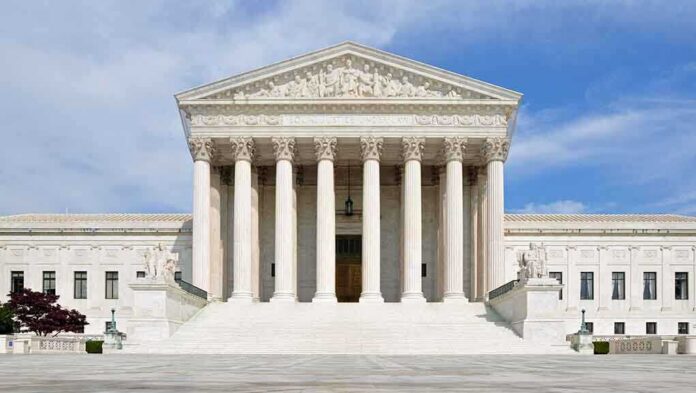
Stacey Abrams asserted that the Supreme Court’s Louisiana v. Callais ruling “dismantled a critical portion of the Voting Rights Act” and triggered states, “largely in the South,” to redraw maps that “eliminate majority-Black voting districts” [1]. She further argued that officials use race-neutral language to mask racial animus, linking current justifications to Jim Crow-era techniques [1]. Her statements set a high-stakes narrative of intentional suppression, positioning Republican-led redistricting as an assault on minority political power with national implications for control of Congress.
However, the research set does not include the opinion text or a legal summary authoritatively describing what Louisiana v. Callais changed in statute or doctrine [1][2]. Without the ruling’s language, standards, or directives, the precise shift in Voting Rights Act protections remains inferred rather than documented here. That gap matters. Sharp claims about dismantled safeguards require the underlying text to confirm which test, threshold, or remedy changed, and how that change would force mapmakers to eliminate or weaken majority-Black districts in specific jurisdictions.
Media Coverage Highlights Political Math, Not Proven Intent
POLITICO’s account underscores that the ruling’s “far-reaching” implications are being processed in Washington through “cold, hard numbers in the House,” where operatives are recasting district lines and forecasting seat counts [2]. That emphasis frames the decision as a power-balancing event rather than a court-sanctioned return to discriminatory practices. The reporting does not present documentary evidence of lawmakers acting with explicit racial intent; it presents a practical scramble over representation with real electoral stakes that both parties are tracking closely [2].
This framing supports a narrower counter-position attributed to Speaker Mike Johnson’s side: the decision is a lawful development in election law, not a revival of Jim Crow [2]. While Abrams argues modern race-neutral claims echo old pretexts [1], the record provided does not contain legislative emails, draft maps, or court findings proving discriminatory purpose after the ruling. Conservatives can therefore read Abrams’s charge as a maximalist narrative built on inference and political anxiety, rather than a demonstrated legal mandate to strip Black voters of representation.
Evidence Gaps Undercut Sweeping “Return Of Jim Crow” Narrative
The cited materials do not supply state-by-state examples showing majority-Black districts eliminated because of Louisiana v. Callais [1][2]. There are no side-by-side maps, enacted bills, court-ordered remedies, or empirical analyses of electoral opportunity presented in the set. The absence of the Supreme Court opinion and the lack of granular legislative documentation create an evidentiary bottleneck. That bottleneck weakens any claim that the decision itself dismantled a specific provision and immediately triggered a measurable loss in Black representation across multiple states.
Conservatives should separate rhetoric from record. Harsh analogies to Jim Crow demand high proof because that era involved explicit, codified barriers to voting and representation. Without the ruling’s text and concrete map outcomes, the claim risks being received as a political weapon, not a verified finding. A measured response is to demand the opinion, concurrences and dissents, lower court records, and post-ruling map changes that can be tested against Voting Rights Act standards and constitutional guarantees, rather than accepting sweeping conclusions on faith.
What To Watch Next: Documents, Maps, And Measurable Impact
Readers should look for three categories of proof: first, the Supreme Court’s opinion detailing any doctrinal shift that would alter how race, data, and remedies are weighed in redistricting; second, enacted maps and legislative records in states Abrams identifies, demonstrating whether majority-Black districts were removed or materially weakened; third, election-performance analyses comparing Black electoral opportunity before and after map changes. Those items, not slogans, can clarify whether this is partisan spin or a structural rollback with constitutional and civil-rights consequences [1][2].
Stacey Abrams Accuses Mike Johnson of Celebrating The ‘Return of Jim Crow’ #Mediaite https://t.co/BSN7vK1qMk
— #TuckFrump (@realTuckFrumper) May 18, 2026
Until those specifics are furnished, conservatives can reject guilt-by-accusation tactics and insist on verifiable facts. Protecting equal voting rights and accurate representation remains nonnegotiable. So does resisting fear-based narratives that paint every legal ruling or map revision as a pretext for oppression. The prudent path is transparency, documentation, and rigorous scrutiny. That approach defends individual liberty, limits government overreach in election design, and keeps the focus on the Constitution instead of inflammatory sound bites that divide the country more than they inform it.
Sources:
[1] YouTube – Stacey Abrams on How the GOP is ERASING Black Voters
[2] Web – The VRA ruling reality check – POLITICO