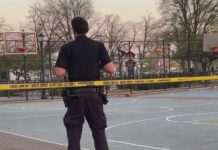
Los Angeles police shot and killed a man armed with a serrated pruning pole after he ignored orders to drop it and kept advancing on officers in Boyle Heights.
Quick Take
- Officers responded to a 911 call about a man swinging a metal pipe near Gillette and Bridge on September 7, 2026.
- The weapon turned out to be an 8 to 10-foot pruning pole with a 10 to 12-inch serrated blade.
- Police say the man ignored commands to drop the pole and kept advancing, prompting an officer to open fire.
- The Los Angeles Police Department (LAPD) is reviewing body camera footage alongside the district attorney’s office.
A Routine Call Turns Deadly In Minutes
Officers with the LAPD’s Hollenbeck Division rushed to Boyle Heights around 9:54 a.m. after a caller reported a man swinging a metal pipe. That description set the tone for the initial dispatch, framing the incident as a possible mental health crisis rather than a violent confrontation from the start.
What officers actually found was far more dangerous than a pipe. Police say the man carried a pruning pole stretching 8 to 10 feet long, tipped with a serrated blade measuring 10 to 12 inches. That kind of tool, built for cutting tree limbs, becomes a different threat entirely when swung at people.
The LAPD says officers gave clear orders for the man to drop the weapon. He did not comply. Instead, according to police, he continued moving toward the officers on scene, closing the distance despite repeated commands to stop.
Officers Tried To Retreat Before Firing
Police accounts indicate officers did not fire immediately. They first tried to reposition and put more space between themselves and the man, a tactic meant to avoid deadly force if possible. When he kept closing in anyway, one officer fired, and the man died at the scene.
No other injuries were reported. No bystanders and no officers were hurt in the exchange, a detail that matters when reconstructing how close and how fast the threat unfolded before the shot was fired.
The pruning pole itself was recovered and logged as evidence, giving investigators a physical object to examine alongside witness accounts and any recorded footage. That step keeps the case grounded in more than just verbal testimony.
Investigation Moves Forward Under Standard Protocol
The LAPD’s Force Investigation Team is working jointly with the Los Angeles County District Attorney’s Office, a standard pairing for any officer-involved shooting in the city. Investigators are reviewing body-worn camera footage, other video, and conducting interviews with officers and witnesses.
Authorities have also raised the possibility that the man was in the middle of a mental health episode, though no diagnosis or documented history has been made public. That question will likely shape how the department talks about training and response options going forward.
Identities of the man and the officers involved have not been released, which is common practice early in these reviews. Investigators say the case remains open, and findings from the coroner’s office and use-of-force review could add more detail to the timeline in coming weeks.
#BREAKING: LA Fire says a suspect was transported to the hospital with a gunshot wound after the LAPD responded to reports of a man armed with a pipe in Boyle Heights Monday morning. https://t.co/bX0OmaLKms pic.twitter.com/P8YD08T4UV
— KTLA (@KTLA) September 7, 2026
Part Of A Larger Pattern In The City
This shooting fits a trend the Los Angeles Times documented in its own review of LAPD data. Edged-weapon encounters made up about 27 percent of police shootings from 2018 onward, and more than 60 percent of those ended in death. Many involved people in a behavioral health crisis rather than career criminals.
Citywide, officer-involved shootings have climbed sharply in recent years, with one analysis pointing to a 62 percent annual increase and noting that many cases involve people suffering a mental health episode. That broader context doesn’t change what happened on Gillette and Bridge, but it explains why cases like this keep repeating across Los Angeles neighborhoods.
For conservative voters watching public safety debates in Los Angeles, the facts here point to a straightforward conclusion. Officers faced a man wielding a bladed weapon who refused commands and kept closing distance. They tried to retreat first. When that failed, an officer used force to stop an active threat, exactly the outcome the public should expect from trained police under those conditions.
Sources:
nypost.com, ktla.com, abc7.com, mynewsla.com, cbsnews.com
© featuredheadlines.com 2026. All rights reserved.