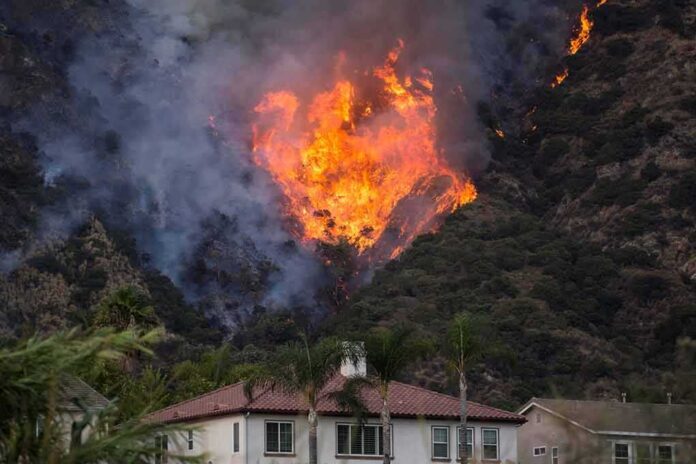
Another Southern California wildfire is ripping uphill toward homes because wind turned a brush fire into an emergency before many residents could process what was happening.
Quick Take
- The Sandy Fire in Simi Valley grew rapidly and forced evacuation orders and warnings across Ventura and Los Angeles counties.
- CAL FIRE reported zero containment early in the incident and said the fire was moving toward Bell Canyon [2].
- Officials and local reporting tied the spread to strong winds and shifting conditions, not to a slow, predictable burn [1][2].
- Fire crews attacked the blaze from the air and ground while residents faced smoke, uncertainty, and a changing perimeter [2][3].
How Fast the Sandy Fire Escalated
The Sandy Fire broke out in Simi Valley on Monday morning and quickly became the kind of fire that punishes hesitation. CAL FIRE reported the fire at 720 acres with 0% containment during an early update, then later listed it at 1,364 acres with the same containment figure [2]. That kind of jump tells you the fire was not sitting still. It was moving through dry brush under conditions that gave crews little margin for error.
Local reporting matched the official urgency. ABC7 said the fire burned at least one home and another structure, while evacuation warnings spread into nearby communities as smoke drifted toward the valley [1]. The Los Angeles Fire Department prepositioned resources in the San Fernando Valley, which is what responsible government looks like when a fire line may change direction without warning. The real story here is not just acreage. It is how quickly a foothill fire can become a regional problem.
Why the Wind Mattered More Than the Flame Front
Wind does not just push flames. It reshapes the battle space. CAL FIRE said a wind shift influenced the fire, and ABC7 reported that flames and smoke were being driven toward the valley [1][2]. That matters because evacuation decisions, aircraft use, and crew positioning all depend on where the fire will be in the next 10 or 20 minutes, not where it was when a resident first saw smoke. Fast fires expose the limits of ordinary planning.
Broadcasters described gusty conditions that helped explain the speed of the spread, and that lines up with what Californians have learned the hard way over the years: hot, dry, windy afternoons can turn a hillside into a conveyor belt for embers. Conservative common sense starts with the premise that nature does not negotiate. When authorities say leave now, families should take that seriously, especially when the fire is climbing toward neighborhoods with little room to retreat.
Evacuation Orders Were the Deciding Line
CAL FIRE issued evacuation orders for multiple Simi Valley zones and warnings for surrounding areas as the fire advanced toward populated corridors [2]. ABC7 reported additional warnings for portions of West Hills and Chatsworth, and Los Angeles Mayor Karen Bass said officials did not expect the wildfire to reach the City of Los Angeles [1]. That statement does not minimize the threat. It reflects the sober reality that fire perimeters can intensify locally even when a larger city remains outside the immediate line of fire.
Sandy Fire breaks out in Simi Valley, prompting evacuation orders and warnings https://t.co/uf6KFcT02K
— NBC 15 News (@mynbc15) May 19, 2026
The evacuation footprint tells the real story of exposure. Once officials start naming zones, animal shelters, temporary evacuation points, and mutual aid, the public should understand that the danger has already crossed from “watch it” to “move now.” Firefighters can fight flames, but they cannot outtalk wind. The strongest public response in these situations is not debate. It is compliance, preparedness, and attention to official updates until the fire behavior becomes more stable.
What the Coverage Reveals About Wildfire Reporting
The public usually sees the drama first: smoke, orange glow, helicopters, and the word “fast-moving.” What arrives later is the better record—incident logs, cause determinations, acreage updates, and containment milestones. In this case, the available material shows exactly why early wildfire coverage can feel chaotic. Acreage numbers changed as the fire grew, and the first hours were defined by urgency rather than neat certainty [1][2][3]. That is not confusion. It is the reality of a live fire.
The important takeaway is simpler than the headlines make it sound. Another wildfire did not just break out in Southern California; another wind-driven fire exposed how quickly suburban and wildland edges can turn into evacuation zones. The people who stayed ahead of it were not the ones waiting for perfect information. They were the ones who understood that when official agencies say immediate threat to life, the clock is already running [2].
Sources:
[1] Web – Simi Valley fire: Sandy Fire burns at least 1 home, scorches more …
[2] Web – Sandy Fire – CAL FIRE – CA.gov
[3] YouTube – Sandy Fire in Simi Valley destroys property, triggers evacuations