
South Korea’s president just put a formal end to the Korean War on the table—and dared Washington, Beijing, and Pyongyang to answer.
Story Snapshot
- President Lee Jae-myung urged talks to replace the armistice with a peace regime.
- The plan includes the United States and China to lock in guardrails and reduce risk.
- North Korea dismissed outreach and blasted Seoul’s U.S. ties, for now.
- Conservatives warn talks reward aggression and want stronger deterrence.
Lee’s Proposal: End the War, Cap the Nukes, Involve the Big Powers
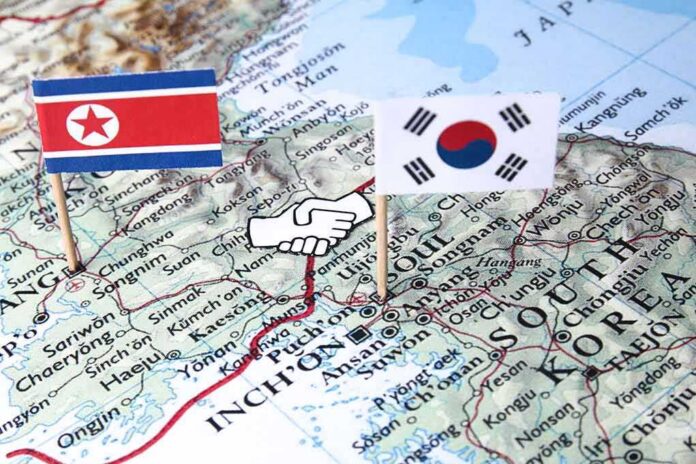
President Lee Jae-myung used Liberation Day to call for direct talks to “end the long-standing war” and shift to a peace framework. He said the two Koreas, the United States, and China should sit down together. He also floated talks on “effective ways” to halt North Korea’s nuclear progress. Those are clear markers: end the Korean War formally, reduce day-to-day risk, and cap the most dangerous weapons, with all key players at the table.
Lee’s team has pointed to a “peace regime” model. That means step-by-step agreements, military risk-reduction tools, and regular channels to keep small clashes from turning large. Think hotlines that work, clearer rules at sea and along the border, and firm penalties for violations. That structure does not trust words; it builds habits and verification. Past U.S. research outlined a two-step approach to move from armistice to peace and then to deeper security deals.
Pyongyang’s Rebuff And The Reality Check
North Korea says it has no interest in Seoul’s proposals and claims Lee stays “confrontational” because he keeps close ties with the United States. That is a familiar script from Pyongyang: reject outreach, blame Washington, and try to split allies. The line matters because it signals the opening bid from the North is still no. It also hints the real work, if any, would likely run through Washington first, not Seoul alone.
North Korea’s stance does not end the effort, but it narrows the near-term path. Any peace track must hold allied unity tight while testing limited steps the North can accept without cashing out leverage. That means sequencing: small de-escalation moves, strong verification, and snapback rules if the North cheats. Talk is not a concession; one-sided gains are. Common sense says never pay twice for the same promise.
Hardline Backlash At Home: Deterrence First, Dialogue Later
Conservatives in South Korea argue engagement rewards bad behavior and drains leverage. A leading conservative platform last cycle made no room for talks. It pushed bigger defense budgets, legal changes to speed a latent nuclear option, and talks with Washington on redeploying United States tactical nuclear weapons or a North Atlantic Treaty Organization-style nuclear sharing plan. That posture wants clear strength now, not possible peace later.
These critics also point to a pattern: every aid package and pause gives Pyongyang time to reload. They argue that only pressure, missile defense, and firm red lines hold the peace. This is not fringe rhetoric. It reflects decades of broken deals by the North. From a conservative lens, a peace regime must be earned through behavior change verified on the ground, not promised in speeches. That bar is high by design—and for good reason.
The Drone Shadow And Why Verification Rules Everything
The policy fight unfolds under a recent, raw legal drama. A Seoul court convicted former President Yoon Suk Yeol of ordering drone flights over Pyongyang in 2024 to stoke tensions and build a case for martial law, sentencing him to 30 years in prison. The case shows how fast security tools can morph into domestic firestorms—and why any peace track must anchor in facts, transparency, and outside checks that endure political swings.
Lee’s plan will rise or fall on three tests. First, allied unity: Seoul must move in lockstep with Washington, not ask for daylight. Second, reciprocity: every concession must trigger a matching and verified step from the North, with snapback terms. Third, enforcement: violations must cost more than compliance. That is how you square strength with outreach. That is also how you avoid the trap of paying for the same freeze twice.
The Narrow Road Ahead: Guardrails Before Grand Bargains
The near-term play is modest and tough. Push military hotlines back online. Freeze large exercises near the border in exchange for a freeze on North Korean artillery drills that threaten civilians. Expand notice windows for missile tests. Re-open recovery teams for Korean War remains with tight monitoring. These moves save lives and build minimal trust. None lift sanctions. Each creates a paper trail and a habit of contact that reduces miscalculation.
Lee’s offer is big, but the smart path is small first. If Pyongyang keeps saying no, Seoul and the United States should keep tightening defense, missile defense, and joint planning. If Pyongyang engages, tie every step to concrete checks. Peace without power is naïve. Power without a plan risks sleepwalking into crisis. The only grown-up answer is both: a cold-eyed peace process built on readiness, verification, and consequences.
Sources:
apnews.com, koreatimes.co.kr, whbl.com, news.sbs.co.kr, upi.com
© featuredheadlines.com 2026. All rights reserved.