

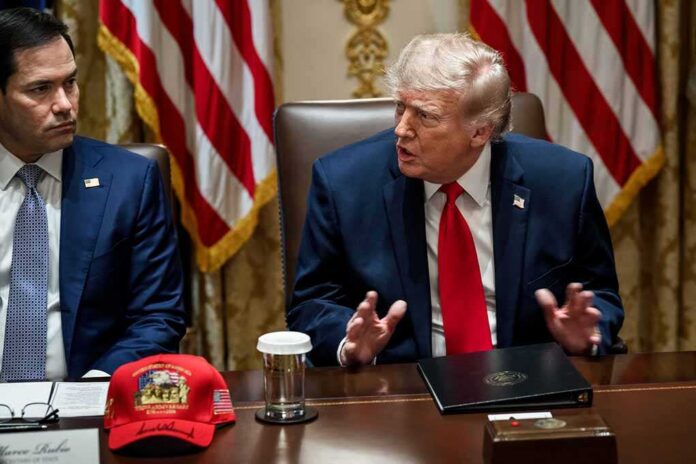
President Trump privately admitted his deportation crackdown went too far, then handed the job of running it to the man who built it.
Quick Take
- The Atlantic reported Trump told people close to him that ICE’s harsh tactics against noncriminal migrants were causing a political backlash.
- Reuters-style reporting says enforcement targets expanded to include migrants who had lived in the country for decades.
- Trump named Stephen Miller, the architect of the deportation strategy, as his new chief of staff right after midterm losses.
- The White House insists enforcement against criminal illegal immigrants will not slow down.
A President Reconsiders After The Votes Come In
Trump started telling advisers that voters still wanted border security, but that rounding up noncriminal immigrants was turning people against him. The Atlantic reported he was hearing directly from business owners whose workers had been deported, and that he seemed open to changing course. That’s a notable admission from a president who built his brand on toughness.
The timing matters. Republicans had just lost both chambers of Congress in sweeping midterm defeats, and multiple outlets tied some of that damage to the deportation campaign. When a political strategy costs your party the House and Senate in the same election, even a hardline president has reason to ask whether the juice was worth the squeeze.
Enforcement had reached far beyond violent criminals. Reports described agents pursuing arrest quotas that pushed them toward migrants who had lived in America for decades, built families, and held steady jobs. That’s a different picture than the “worst of the worst” framing the administration used to sell the crackdown to voters in the first place.
The Miller Appointment Sends A Different Signal
Three days after the midterm wipeout, Trump named Stephen Miller as his 33rd White House chief of staff. The official announcement praised Miller for “securing the border at unprecedented levels” and called him “one of my most trusted advisors”. Nothing in that statement mentions easing up, legalizing anyone, or rethinking enforcement priorities.
Miller is widely described as the driving force behind the aggressive deportation push, the same push reportedly fueling Trump’s private doubts. Immigration hawks inside and outside the administration treated his promotion as proof their approach had won the internal argument. That reaction cuts hard against any narrative of the White House softening its stance.
What The White House Is Actually Saying Out Loud
Publicly, the administration has drawn a firm line. The White House said flatly it would not slow efforts to arrest and deport criminal illegal immigrants, and a Homeland Security spokesperson said ICE was “not backing away or slowing down”. Spokeswoman Lauren Bis credited Miller with spearheading the crime crackdown and securing the border, framing it as a success story, not a mistake to correct.
That’s the tension readers need to sit with. One version of events has Trump privately worried enforcement went too far and cost his party votes. The other has his own White House publicly doubling down and elevating the man most associated with the toughest tactics. Both things were reported within days of each other, and neither cancels the other out.
This Isn’t The First Time Washington Has Faced This Choice
America has wrestled with this exact tradeoff before. The 1986 Immigration Reform and Control Act paired tougher enforcement, including sanctions on employers who hired undocumented workers, with legal status for roughly 2.6 million people already here. Congress has leaned on enforcement-plus-legalization deals repeatedly rather than picking one extreme and sticking with it permanently.
That history suggests Trump’s reported second-guessing isn’t some radical break from precedent. It’s a familiar fork in the road: deter future illegal crossings hard, while deciding what to do with people already rooted in American communities for years. Conservatives who back strong borders can still ask whether deporting longtime workers with no criminal record actually serves that goal, or just generates backlash without making the country safer.
What Still Needs An Answer
No executive order, bill, or on-record presidential statement has confirmed a policy change. The Atlantic’s reporting describes private conversations, not a signed directive. Until Trump says so publicly, or Congress sees actual legislative text, this remains a reported reassessment, not a finished decision. Americans who want clarity should watch whether Miller’s enforcement numbers change in the coming months, since that will answer the question louder than any private conversation ever could.
Trump on 60 Minutes: “The deportation policy was too tough and it hurt me in the midterms.” 😳Same day: he names Stephen Miller, the architect of that policy, as his new chief of staff. 👀He admits it went too far… then promotes the man who pushed it the https://t.co/cRZAfsUqZF…
— Canzian (@Tshow0) November 9, 2026
For now, the facts sit side by side without resolution. A president reportedly worried his crackdown backfired just promoted its chief architect to run his entire White House. Voters will likely judge the administration not by what Trump allegedly said behind closed doors, but by what ICE actually does at the next doorstep.
Sources:
facebook.com, whitehouse.gov, wsj.com, amp.dw.com, houstonchronicle.com, politico.com
© featuredheadlines.com 2026. All rights reserved.