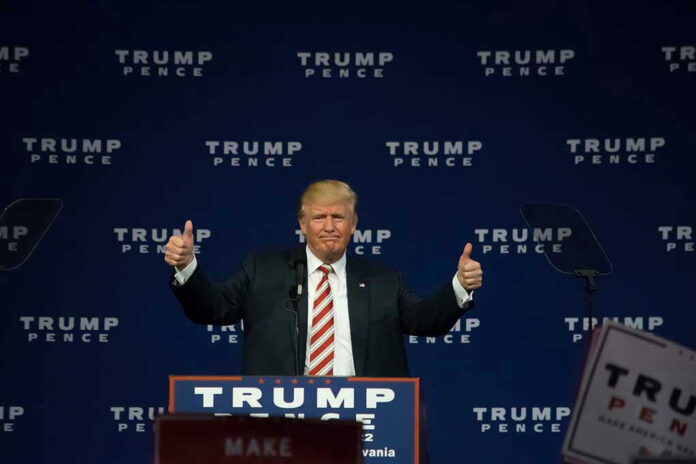
Donald Trump has turned Republican primaries into his own scoreboard, and last night he added another row of wins.
Story Snapshot
- Trump and his allies are loudly claiming a “perfect” or near-perfect endorsement night in Republican primaries.
- Ballotpedia shows Trump-backed candidates have posted a very high win rate in recent primary cycles.
- Much of that record comes from races where his candidate was already favored or even unopposed.
- Serious research suggests his brand can hurt in a general election even while it helps in a primary.
Trump’s New Victory Lap And What It Really Means
After the latest round of primaries, Trump-world blasted out a familiar message: the endorsement magic is alive and well. Fox News has highlighted nights where Trump bragged about a “37-0” sweep, telling reporters, “We won all races last night. Every one of them,” as proof that he “owns” the Republican Party from coast to coast.[6] That same framing now shows up in social posts cheering a “boosting” endorsement record after Tuesday’s contests.[5] The story is simple: get Trump’s blessing, get the win. The reality is more layered and more interesting for conservatives who care about actually winning power, not just headlines.
Ballotpedia’s numbers show why the bragging has teeth in primaries. In Republican primaries held before mid-September 2022, Trump-endorsed candidates won 159 of 176 contested races, about a 90 percent success rate.[2] That is an eye-popping number in any era. It says Trump’s seal of approval usually goes on the candidate who walks away with the nomination. For voters who see Trump as the party’s leader, this looks like confirmation that the movement is not just alive but dominant inside Republican ranks.
How Selection, Not Magic, Inflates The Win Rate
Raw win rates, though, can flatter any politician who picks spots wisely. Ballotpedia notes that a large chunk of Trump’s overall primary “wins” come from races where his candidate faced no real challenge, including many unopposed contests.[2] Those races would have gone in the same direction without a Mar-a-Lago press release. This does not mean the endorsement is meaningless. It means some share of that 90 percent is baked in by the map, the moment, and the strength of the candidate Trump chose to hug.
That pattern repeats across cycles. Brookings looked at Trump’s midterm endorsements and found that, in House and Senate races, about 55 percent of his backed candidates won their general election contests.[1] That is better than some Republican figures, like Mike Pence, but weaker than Barack Obama and Joe Biden’s endorsees and weaker still than Bernie Sanders’s.[1] The numbers hint at a divide that many Republican strategists quietly admit: Trump’s blessing can be a rocket booster in a Republican primary, but it can turn into a weight belt once independents and suburban moderates enter the picture.
Research: What A Trump Endorsement Does To Voters
Political scientists have tried to measure Trump’s effect on real voters rather than just counting wins. A peer-reviewed study in the journal “PS: Political Science and Politics” used a survey experiment to test how a Trump endorsement shifted support for a hypothetical Republican candidate.[2] The authors found that Trump’s endorsement “reduced the likelihood of voting for” the candidate by about four percentage points overall.[2] Democrats became 11 points less likely to back the candidate after hearing about Trump’s support, while Republicans did not show a big, across-the-board surge.
President Trump boosting his endorsement record after last night’s primaries across the country.
Following Tuesday’s elections, Trump-endorsed candidates are 149-1 in Republican primaries, giving the president a 99% success rate.
The results are adding to the growing evidence… pic.twitter.com/NH4TMX8pNP
— The Q Panther (@TheQPanther) June 10, 2026
That finding lines up with common sense conservative worries. A Trump nod may light up the base in a spring primary, when the electorate is filled with loyal Republicans. But in November, when the audience includes swing voters, college-educated suburbanites, and frustrated independents, the same Trump stamp can turn into a red flag. In other words, the endorsement can act like fertilizer in one soil and acid in another. A smart party treats those conditions as real, not as “fake news.”
Why Republican Primaries Now Revolve Around Trump
Media stories are right about one thing: Republicans who cross Trump often struggle to survive primaries. Reporting on recent primary cycles, outlets like PBS have noted that “signs this year suggest” there is little room inside the party for Republicans who break with Trump, as he has “repeatedly” rallied supporters to punish his critics.[4] High-profile races where Trump-backed challengers ousted long-time incumbents make that point in vivid color. The message to ambitious Republicans is clear: question Trump, and you invite a very public beating.
That fear helps explain why so many candidates chase his endorsement. In some states, Trump has backed dozens of hopefuls at once, creating the sense that his sticker sits on almost every piece of Republican packaging.[1][2][5] Once that happens, the endorsement becomes less a test of “Trump versus the field” and more a loyalty signal that tells primary voters which candidate has bent the knee furthest. For a movement that values strength, border security, and fighting the left, that loyalty test feels satisfying. But it can also screen out serious, independent-minded conservatives who might sell better in purple districts.
How Conservatives Should Read The Scoreboard
For conservatives who want to stop the left’s agenda, the key question is not whether Trump’s endorsement record looks strong on Fox chyrons. The question is whether those flashy primary wins translate into more Republican governors, senators, and members of Congress who can actually pass policy. When Brookings shows Trump’s endorsees underperforming Obama’s and Biden’s in general elections,[1] and academic research shows his brand can repel swing voters,[2] it suggests a risk: a party that wins the nomination fight and loses the war for the middle.
Common-sense conservative strategy starts with an honest read of the data. Yes, Trump has real pull in Republican primaries, and last night’s results add to that story.[2][5][6] Yes, candidates ignore that power at their own peril. But a movement that wants secure borders, lower inflation, and judges who respect the Constitution must think beyond one man’s win-loss record. The scoreboard that matters most is not a perfect night in June. It is who holds the gavel and the veto pen in January.
Sources:
[1] Web – President Trump boosting his endorsement record after last night’s …
[2] Web – Trump made 30 endorsements in recent primaries. Here’s who won.
[4] Web – Trump endorsed 75 candidates in the midterms. How did they fare …
[5] YouTube – Trump’s endorsement record isn’t as strong as he says
[6] Web – Endorsements by Donald Trump – Ballotpedia
© featuredheadlines.com 2026. All rights reserved.