
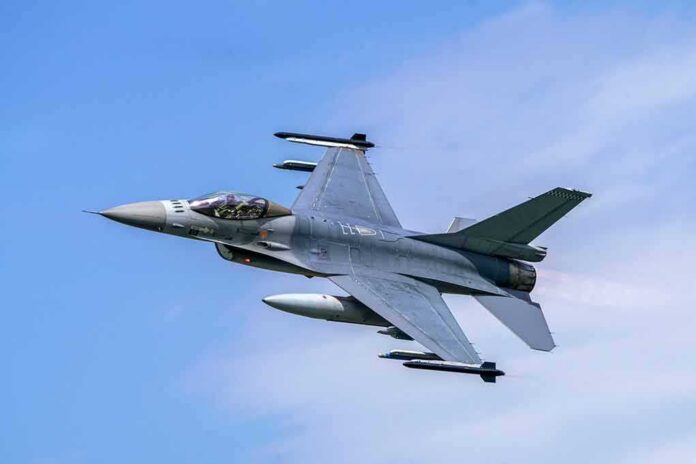
Romanian F-16s shot down two fast-moving drones inside Romanian airspace and over its Black Sea waters within minutes, and the timeline is tight enough to make any adversary think twice.
Story Snapshot
- Two drones entered Romanian airspace near Sulina and were downed minutes apart.
- Two Romanian F-16s scrambled from the 86th Air Base after radar detection.
- Officials linked the drones to the Geran family based on speed and type.
- The intercepts fit a rising pattern of incursions tied to the war near NATO borders.
What Romania Says Happened, Down to the Minute
Romania’s defense minister laid out a brisk clock. Radar flagged targets and the alert launched two F-16s from the 86th Air Base at Borcea. Authorities said the first drone crossed into Romanian airspace at 17:59 local time and was shot down within two minutes. The second was engaged and destroyed at 18:05. Officials placed the intercepts roughly 25 kilometers southeast and 20 kilometers east of Sulina, within Romanian territorial waters.
The Ministry of National Defence said the fighters were already on air policing duty and moved to intercept once controllers tracked a group of aerial targets offshore. The ministry’s account described a standard quick reaction procedure: detection, scramble, intercept, and fire. That sequence matches how Romania and other North Atlantic Treaty Organization members defend coastal airspace near the Black Sea during high-tempo periods of the Russia–Ukraine war.
The Aircraft, The Targets, and The Calls
Officials identified the jets as F-16s from Borcea and described the targets as jet-powered attack drones. They tied the likely model to the Geran family, citing an estimated speed near 450 kilometers per hour and the drones’ profile. Statements connected this to Russia’s known use of Geran variants in the region. Some outlets repeated “Russian drones” as a shorthand. Romanian officials, however, pointed to observed performance and type when explaining the call.
Romania’s public brief included when the fighters launched, when missiles were fired, and where wreckage fell. That level of detail stands out in an area where air and sea borders sit close to active combat zones. It also shows a government comfortable stating the facts quickly, which helps signal control and calm to citizens and allies alike. The core account appeared across multiple major outlets that quoted Romanian authorities directly.
Why This Intercept Matters for NATO’s Southern Flank
The Black Sea is now a live test of air defense discipline. Romania shares a long border with Ukraine and has faced spillover risk since the first months of the war. Reported incursions and drone debris finds have risen over time. One analysis noted Romania’s defense ministry recorded 30 drone-related incidents between January and late September 2026, a steep jump over prior years. That shift explains the faster trigger and tighter patrol patterns along the coast.
Romanian F-16 fighter jets shot down two drones over the country’s Black Sea territorial waters on Saturday, engaging each within minutes of entry in what Defense Minister Radu Miruta called Romania’s first intercept of the faster, jet-powered version of Russia’s Shahed-type… pic.twitter.com/AjX7abRsHu
— Jim Manzon (@manzonjj) October 19, 2026
Romania’s firm response sets a plain rule: national airspace is a hard line. That view fits American conservative principles about borders, deterrence, and peace through strength. States owe their people secure skies. When hostile or unknown craft cross the line, the response should be clear, quick, and proportionate. This intercept checks those boxes. It also gives the North Atlantic Treaty Organization a recent, concrete case of a member acting inside its rights, with no confusion over whose airspace was breached.
The Escalation Risk, Managed by Speed and Clarity
Border defense near a war zone always carries risk. Speed and clarity help keep that risk in bounds. Romania’s timeline left little room for accident or drift. Controllers tracked the group offshore, scrambled on radar cues, and prosecuted two tracks that entered and then moved inside Romanian jurisdiction. The public readout showed confidence in the command chain, from detection to weapons release. That matters when every delay can pull allied ships and nearby towns into danger.
Some reports framed the drones as Russian-made Geran-4s. Romanian officials linked the type based on speed and category and spoke in those terms. That is a responsible approach: identify the threat you can see and defeat it, while letting technical teams sort the finer points later. For the purpose of air defense, the exact sub-variant does not change the duty to protect your airspace.
What to Watch Next Along the Coast
Expect tighter coastal patrols, more layered sensors, and quicker alerts to mariners. Romania will likely fine-tune engagement zones near Sulina and along approaches to the Danube Delta. Allies will study the intercept to measure radar coverage, scramble times, and missile choice. That yields better playbooks for the next beachhead test, whether it comes at dusk, in bad weather, or during a mass strike window across the border.
Bigger picture, the Black Sea is a pressure valve for the wider war. When national airspace holds, escalation cools. When it does not, pressure climbs. Romania showed that firm lines, fast fighters, and steady controllers can reset the balance in minutes. That is how you keep a regional war from spilling into allied towns and ports, and how you tell any prowling drone that the coast still has guardians on the wing.
Sources:
theaviationist.com, dw.com, euronews.com, internazionale.it, romania-insider.com, defence-industry.eu, ianslive.in
© featuredheadlines.com 2026. All rights reserved.