
Trump said Iran “is dead,” then hours later ordered fresh U.S. strikes—so what actually changed in Tehran?
Story Snapshot
- Trump said top-level talks led him to cancel planned strikes on Iran that night.
- He cast the campaign as “massive and ongoing,” with thousands of targets hit.
- Reuters and the Associated Press reported a push to open the Strait of Hormuz and pause tit-for-tat attacks.
- Counterreports said Iran’s regime remained in place and still resisted.
Trump’s Claim: Pressure Worked and Strikes Could Pause
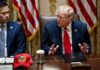
President Trump told the public that negotiations reached Iran’s top leadership and that planned strikes were canceled because a deal had been essentially accepted. He said the talks had been “approved” at the highest level of the Islamic Republic, and that he stood down that evening’s operations as a result. He also described the U.S. effort as a sustained, heavy campaign, not a one-off hit, pushing for regime change and compliance under continued pressure.
The administration’s official remarks claimed more than 7,000 targets across Iran had been struck since the conflict began, signaling a scale meant to break Tehran’s will and capacity. Trump also tied the pressure to concrete terms: halt cross-border strikes, open the Strait of Hormuz right away, and move toward a signed arrangement within days if Iran complied. That framing sets a clear test. Ships move safely or the hammer drops again. Tehran behaves or the campaign resumes.
What The Battlefield Picture Suggests So Far
Reports cited U.S.-protected shipping lanes, escorts moving vessels out of the choke point, and sharp blows against Iranian naval assets. A Fox segment quoted a retired officer claiming the Navy destroyed large numbers of Iranian ocean-going ships and small boats, and damaged ports and maritime infrastructure. That account, while compelling, came from broadcast commentary, not a formal damage report. It points to degraded capability, but it is not an official tally with photos, logs, and assessments.
Reuters and the Associated Press documented public messaging around pauses and de-escalation, with both Iran and Israel announcing they had halted direct strikes after Trump’s appeal. That line supports the leverage theory: pain first, pause second, deal if possible. The White House then coupled that pause with a warning that noncompliance would bring immediate and harsh responses, up to leadership-level consequences if Tehran resumed attacks. That threat set the tone for later renewed strikes when warnings went unheeded.
The Counter-Argument: Iran Is Hurt, Not Done
Several outlets mapped a different picture. Reuters said Iran emerged “battered but standing,” keeping its core political system and bargaining chips. The British Broadcasting Corporation described functioning command structures and state apparatus weeks into the war, with replacements drawn from the same ideological ranks, which signals resilience rather than collapse. National Public Radio said six months in, the regime had not fallen and had even hardened its stance. These accounts challenge the idea that Iran as a state was “dead.”
That pushback does not deny U.S. strikes landed. It centers on end state. A regime can take hard hits, lose ships and depots, and still govern, mobilize, and fire back. The Just Security analysis argued Iran built its military to ride out decapitation strikes and communications loss, using a mosaic structure designed to fight on through disruption. That design blunts outside shock and buys time to recover or stall. Common sense says you do not declare checkmate until the king cannot move.
How To Square The Circle: Victory Claims Versus Durable Outcomes
Two clocks tick at once in coercive campaigns. The political clock rewards fast, bold claims that shape behavior now. The military clock runs slower and needs battle damage assessments, shipping logs, and verified before-and-after photos. Trump’s claims about 7,000 targets and Strait conditions aimed to force decisions in hours and days. The counterreports measured whether the regime still stood months later, which they say it did, though bruised. Both can be true in different windows.
#BREAKING Trump to Fox News: We are going to hit Iran hard. There will be a response. #Trump #KingStellaxWilliamEstLIVE
— Indian Development & Infra (@Defence1100) August 31, 2026
Judged by American conservative values, the standard is simple: protect Americans, restore freedom of navigation, and punish aggression until bad actors stop. If escorts are flowing and mines are neutralized, that meets the test today. If Iran’s rulers still command tomorrow, keep the pressure on. The right measure of success is not one viral line. It is whether tankers transit safely, proxies stand down, and Tehran yields on the terms that guard U.S. interests, week after week.
Sources:
cnn.com, aljazeera.com, cnbc.com, bbc.com, reuters.com, en.wikipedia.org, jns.org, apnews.com, foxnews.com
© featuredheadlines.com 2026. All rights reserved.