
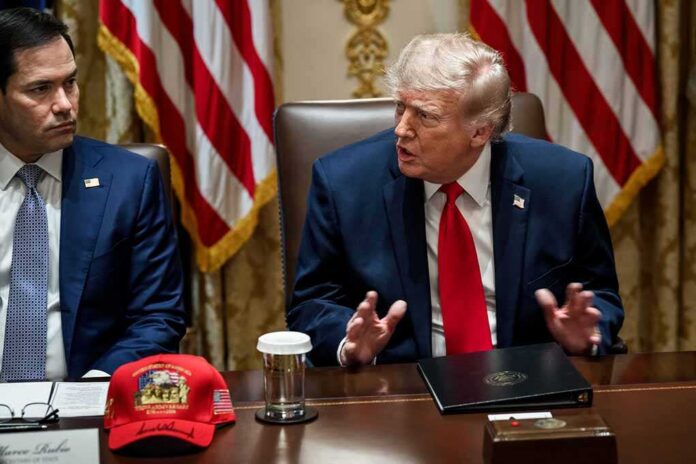
President Trump flatly denied that Secretary of State Marco Rubio warned him about an alleged Chinese spy tied to Nvidia’s chief during the May China trip, and that single sentence now drives a national-security storm around politics, business, and proof.
At a Glance
- Trump said he did not hear a spy warning during the May China trip.
- Trump said Jensen Huang denied knowing the woman was a spy, and he believes him.
- Reports claim Rubio briefed Trump; Rubio has not confirmed it.
- Nvidia says no evidence yet that secrets or national security were compromised.
The on-record denial versus off-record claims
President Trump told reporters in November that he did not get warned on the plane in May. He gave a crisp answer: he did not hear about it then. That is the only on-camera, on-the-record statement from a principal. Anonymous sources offered a different account. Reporting said Rubio briefed Trump aboard Air Force One. Those reports cite unnamed officials and a classified memo that the public has not seen. Rubio declined comment, citing the nature of the issue.
Readers should separate what is proven from what is argued. There is a clear presidential denial on tape. There is also a stack of media stories about a briefing, built on leaks and a memo still under wraps. That is not nothing, but it is not the same as a released record. Conservative common sense says claims that move markets and hit reputations deserve receipts. Until then, weigh on-the-record statements more than whispers.
What Trump says about Huang and why it matters
Trump said he asked Jensen Huang if he knew the woman was a spy. He said Huang answered that he did not, and Trump said he believes him. That belief threads through a wider policy stance. The United States wants strong domestic chip leaders, yet also wants to block China from leaping ahead in artificial intelligence. A leader can both defend due process for an executive and demand tough guardrails around technology and trade. That balance is the adult job here.
Nvidia sits at the center of the artificial intelligence race. Any hint of compromise is market-moving. The company announced an independent probe and told investors it had no reason to believe company secrets or national security were compromised so far. That update does not clear every question, but it narrows the panic. If investigators find no data loss, the public fight shifts back to who knew what, when—and whether media got out over its skis.
The unresolved spy claim and the risk of narrative creep
Coverage often fuses three questions into one messy headline: Was Trump warned? Was the woman an agent? Did any sensitive data leak? The record does not pin down all three. Reports describe dispute among officials about the espionage assessment’s strength. Nvidia says it sees no evidence of compromise, while it keeps digging. Those are separate tracks. Americans should not let a tangle of leaks turn uncertainty into a verdict. Keep the lanes distinct until evidence lands.
Podcast Summary | The Diary Of A CEO with Steven Bartlett: Ex-CIA Officer: Trump Knew About The China Spy And Didn't Care! | John Kiriakou & Aliia Roza
Overview
A former Russian honey-trap operative and a former CIA officer argue that the real intelligence threat is human:…— Podcast Quickie (@podcast_quickie) November 16, 2026
China’s government called the allegation groundless and a smear. That is Beijing’s script whenever a counterintelligence story breaks. Washington should not take cues from a rival’s press office. But neither should it convict by rumor. The right move is disciplined process: declassify what can be released, log who briefed whom, and finish the corporate probe. If a memo exists that names recipients and dates, Congress can secure it and settle the Air Force One dispute.
What would settle this fast
Three steps would close the loop. First, produce the alleged Rubio memo or any record of a May briefing and list who received it. Second, take sworn testimony from Rubio in a closed classified session, then release a public summary that does not burn sources. Third, let Nvidia’s independent probe finish and release a plain-English report that answers whether any systems, devices, or export-controlled data were touched. Those actions beat months of drive-by leaks.
How to judge the claims without the memo
One fact sits on video: Trump’s denial. Another sits in company filings and statements: no evidence yet of compromised secrets. Media reports cite intelligence intercepts and a classified assessment, but the details stay sealed. On weight, public, attributable facts deserve more trust than unnamed sources. That is not a free pass for anyone; it is a call for proof. If stronger evidence appears, views should shift to match it. Until then, keep claims in separate bins.
Sources:
facebook.com, bbc.com, reuters.com, edition.cnn.com, bbc.co.uk, independent.co.uk
© featuredheadlines.com 2026. All rights reserved.