Eight Marines were hurt by an Iranian missile, and the Pentagon said little until the paperwork showed up.
Story Snapshot
- Eight U.S. Marines were injured when an Iranian cruise missile hit a vessel in the Strait of Hormuz on Sept. 14, according to U.S. officials reported by NBC News.
- The injuries were described as non-serious; all eight returned to duty soon after.
- The Pentagon did not publicly disclose the attack when it happened; the wounded were added to the casualty database later.
- The delay fits a wider pattern of slow, uneven public reporting on war injuries.
What happened in the Strait of Hormuz on Sept. 14
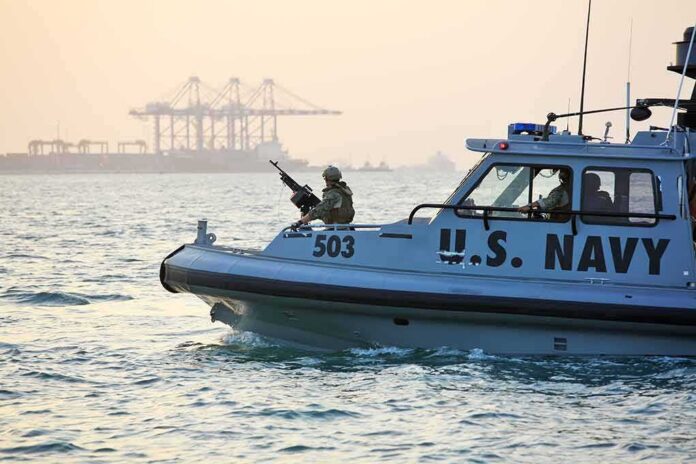
U.S. officials told NBC News that an Iranian cruise missile struck a vessel operating in the Strait of Hormuz on Sept. 14. Eight Marines on board were injured. Officials described smoke inhalation and possible mild brain injuries, including concussion-like headaches. The Marines did not need long-term care and soon returned to duty. Central Command did not issue a public alert at the time. The event surfaced later through media and database updates.
The location matters. One fifth of the world’s oil passes through the Strait of Hormuz. Iran knows that a strike there grabs attention and tests U.S. resolve. A cruise missile hit on a U.S.-operated vessel is a clear signal of risk. It also probes U.S. red lines without causing mass casualties. That kind of gray-zone pressure is Iran’s playbook. Minor injuries and quick returns to duty keep the temperature below open war but still raise the stakes.
How the injuries were handled and recorded
Reporters learned that the eight Marines were later added to the Pentagon’s public casualty database. The Washington Post found that the Pentagon also added 29 wounded sailors that week, lifting the total wounded since hostilities began to hundreds. The update was quiet, not announced with a briefing or release. This practice puts facts into an official ledger while avoiding a headline wave on the day of the strike.
Officials and coverage framed the injuries as not serious and consistent with smoke exposure and possible mild brain trauma. That tracks with U.S. medical policy in deployed settings. Leaders must report potentially concussive events fast and rest troops for at least 24 hours if no concussion is diagnosed. Quick return to duty does not mean the event was trivial; it means doctors cleared the Marines for their mission after checks and rest.
Why disclosure lagged and why that matters
Delayed disclosure is not new. The Pentagon’s casualty website often lags events by days or weeks. Media and lawmakers have pressed the department over slow or shifting numbers since the Iran war heated up. Some officials say quick-return injuries do not require immediate public release. Critics answer that families, taxpayers, and Congress still deserve timely notice. Quiet updates avoid panic but also blunt accountability when adversaries test U.S. forces.
From a common-sense, conservative view, two things can be true at once. First, commanders must protect operations. They should not broadcast every hit in real time. Second, the country needs a clear and steady picture of risk and cost. A short, same-day statement could have met both needs: “Eight Marines evaluated. No critical injuries. Mission continues.” That message tells adversaries we are not rattled and tells Americans we are not in the dark.
The Iran playbook and the American response
Iran’s strike fits a pattern of pressure without tipping into direct war. It tests defenses, morale, and political will. The American answer should be simple and firm. Protect the lanes. Broadcast resolve. Publish timely facts that neither hype nor hide. When the public sees a calm, prompt accounting of wounds and recovery, support holds. When facts trickle through leaks and database edits, faith slips, and Tehran reads hesitation, not prudence.
Eight U.S. Marines were injured in an Iranian cruise-missile strike on a vessel in the Strait of Hormuz on Sept. 14, NBC News reports.
The Pentagon’s public Iran-war tally has since risen to 861 wounded.— GlobePulses (@GlobePulses) September 28, 2026
The Marines returned to duty. That is good news. It also raises a basic standard for the future. If troops are well enough to get back to work, leaders are well enough to tell the country what happened. That does not mean naming units or tactics. It means a brisk, factual line on the record. Sunlight shows strength. It also closes the space where rumor and propaganda grow.
Sources:
mediaite.com, iranintl.com, themedialine.org, bignewsnetwork.com, maritime-executive.com, bloomberg.com, hindustantimes.com, ground.news
© featuredheadlines.com 2026. All rights reserved.